
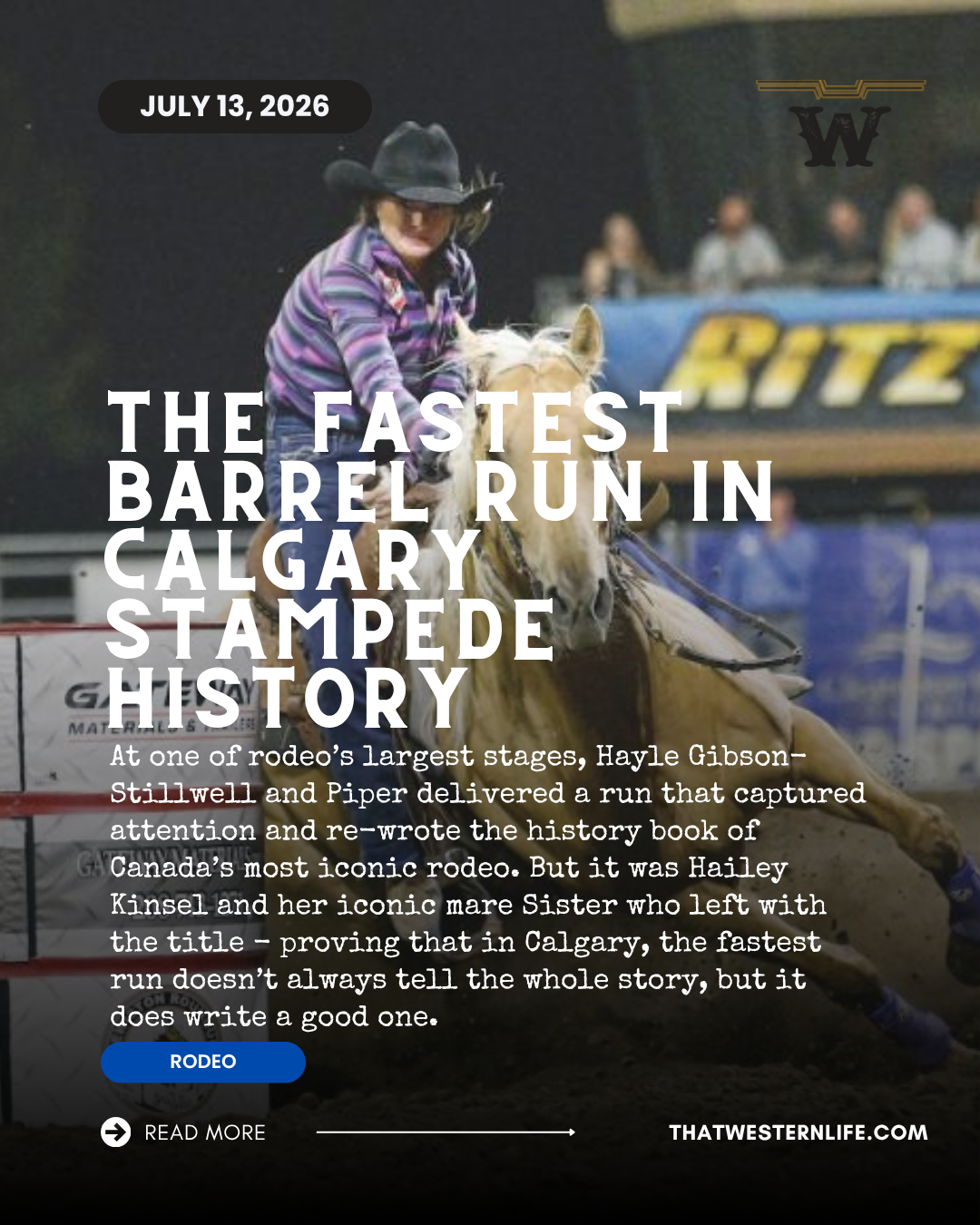
Hayle Gibson-Stillwell and Piper Rewrite the Calgary Stampede Record Book
At one of rodeo’s largest stages, Hayle Gibson-Stillwell and Piper delivered a run that captured attention and re-wrote the history book of Canada’s most iconic rodeo. But it was Hailey Kinsel and her iconic mare Sister who left with the title - proving that in Calgary, the fastest run doesn’t always tell the whole story, but it does write a good one.
Hayle Gibson-Stillwell delivered one of the defining performances of the 2026 Calgary Stampede on Sunday.
Gibson-Stillwell and her mare, Buncha Dinero (aka Piper) completed the barrel pattern in 16.56 seconds during te July 12 semifinals, producing the fastest run of the week and one of the quickest times ever seen in Calgary.
The run did more than move Gibson-Stillwell forward in the competition.
It quickened a standard that had already been challenged earlier in the week, illustrating the extraordinary level of horsepower and precision on desplay at this year’s Stampede. At this level, records are not falling becuase riders are taking reckless chances. They are falling because small improvements in a horse’s stride, footing, positioning, and responsiveness can separate an excellent run from a historic one.
However, despite posting the fast time, Gibson-Stillwell did not officially leave Calgary with the 2026 Calgary Stampede Barrel Racing Champion title.
That distinction still belongs to Hailey Kinsel, who ultimately secured the Stampede title. Calgary’s format, built around qualifying rounds, seminfinals, and a winner-takes-all final, means that times from earlier rounds don’t always carry the same weight as performances in the championship round. Kinsel’s consistency across te entire structure, combined with a clutch performance wen it mattered most, allowed her to claim the title even without the single fastest run of the week.
It is a reminder that Calgary is not simply about speed.
It is about timing, consistency, and delivering under the highest pressure moment of the rodeo.
The Stampede places competitors in front of a large international audience, significant prize money and one of the most recognizable crowds in western sports. Horses must manage the noise, travel ground conditions and repeated high-pressure runs while remaining physically and mentally sharp.
That makes Piper’s performance particularly significant, even without the official championship title record atached.
Successful barrel racing is often discussed as though the rider simply chooses the fastest horse. In reality, elite runs depend on a partnership built through conditioning, veterinary and farrier care, hauling strategy, confidence and thousands of decisions made before the horse enters the arena.
A 16.56 second result represents years of preparation compressed into less than 17 seconds on an international stage.
Adding another layer to the story, Piper and Kinsel’s legendary mare, Sister, share bloodlines. The connection highlights how breeding proframs continue to shape the upper tier of barrel racing, where elite genetics, careful development and experienced riders combine to produce horses capable of competing at the highest level.
That conversation around bloodlines naturall leads to some of the most respected names in the industry: Sherry Cervi & Mel Potter. Their breeding program has beome synonymous with producing elite barrel horses that consistently perform at the highest levels of the sport. Cervi, a multi-time world chhampion, and Potter have built their program on a deep understanding of what it takes to win - not just in terms of speed, but in durability, mindset, and consistency under pressure.
Thier horses are not accidental standouts. They are the result of intentional crosses, careful selection and years of experience competing at the very top. When you see horses like Piper and Sister sharing lineage and rising to the biggest stages, it reinforces what programs like Cervi and Potter’s have proven for years: great horses are built long before they ever enter the arena.
The performance also creates a strong promotioanl opportunity for women’s rodeo.
Barrel racing consistently produces some of rodeo’s most recognizable athletes and most shareable moments. A visibly fast run, whetehr or not it becomes the official arena record or championship title earner, gives broadcasters, events, and sponsors content that can travel well beyond established rodeo audiences.
The Calgary Stampede is formatted to reward complete performances and championship formats for major rodeos shape outcomes and how the next generation of elite horses, often connected by bloodlines, contine to push the limits of what is possible.
At one of rodeo’s largest stages, Hayle Gibson-Stillwell and Piper delivered a run that captured attention and re-wrote the history book of Canada’s most iconic rodeo. But it was Hailey Kinsel and her iconic mare Sister who left with the title - proving that in Calgary, the fastest run doesn’t always tell the whole story, but it does write a good one.
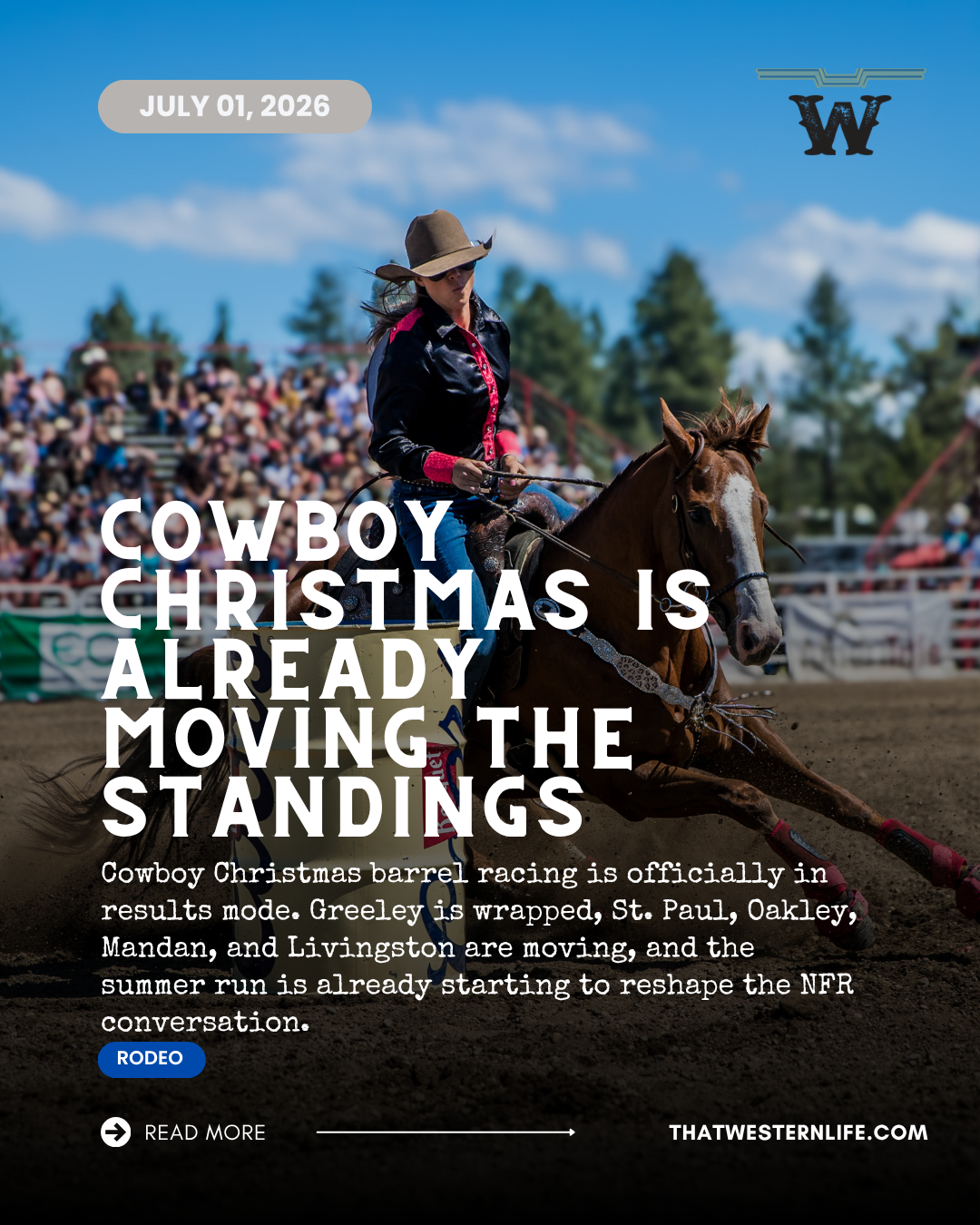
Cowboy Christmas is Already Changing the Barrel Racing Conversation
Cowboy Christmas barrel racing is officially in results mode. Greeley is wrapped, St. Paul, Oakley, Mandan, and Livingston are moving, and the summer run is already starting to reshape the NFR conversation.
Cowboy Christmas is officially moving from preview mode into results mode, and the barrel racing race is already getting sharper.
At Greeley Stampede, Ceily Simpton won the finals with a 17.13-second run, while Raelin Jurgens won the average with 51.93 seconds on three head. Greeley is one of the early tone-setters of the Fourth of July run. A strong finish there can give a cowgirl more than money. It can give her confidence, momentum, and a stronger position heading into one of the most demanding weeks of the season.
But Greeley is only one piece of the map.
Early Cowboy Christmas results also show Hayle Gibson-Stillwell leading at St. Paul, BryAnna Haluptzok leading at Oakley, Hailey Kinsel leading at Mandan, and Kellie Jorgensen leading at Livingston. Those names are spread across several rodeos, but together they tell the real story: the summer run is happening now.
For barrel racers, this week is brutal and valuable at the same time. The schedule is packed, the hauling is intense, and horses have to stay sharp through different ground conditions, arena setups, and travel demands. A fast time is never just a fast time. It is the result of horse management, timing, confidence, and decision-making under pressure.
That is why Cowboy Christmas is one of the most important stretches in professional rodeo. It can push someone closer to the National Finals Rodeo conversation or make the rest of the summer feel much more urgent.
For That Western Life, this is the kind of rodeo story worth covering closely because it helps fans understand how the season is built. The NFR field does not appear out of nowhere in the fall. It is shaped through weeks like this, where every run, every check, and every horse decision matters.
The headline is simple: barrel racing’s summer run is already moving.
And the cowgirls who capitalize now may be the ones we are still talking about in December.
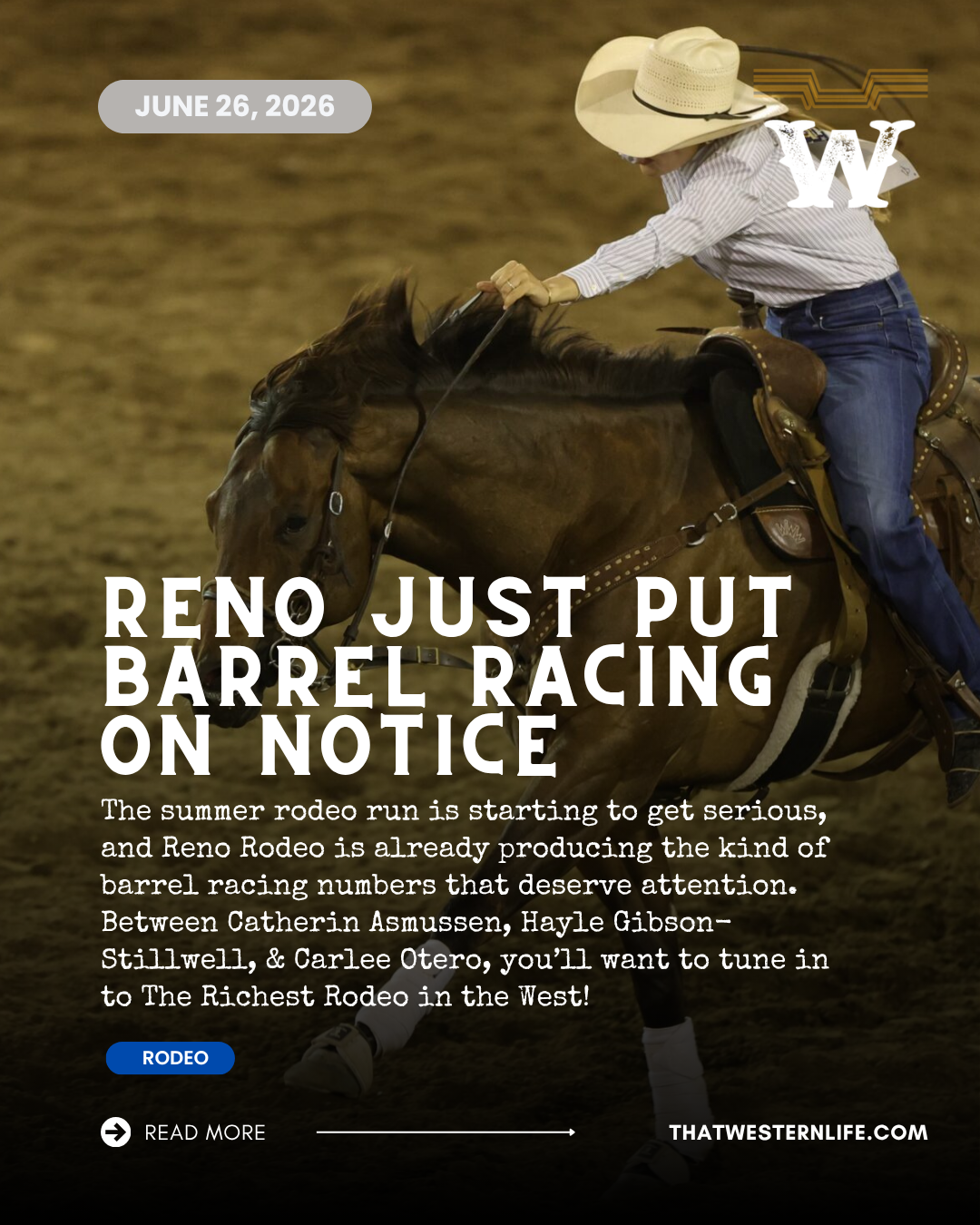
Reno Rodeo is Giving Barrel Racing Fans a Reason to Pay Attention
Reno Rodeo is already giving barrel racing fans something to watch. Catherine Asmussen’s 16.76 in Round 2 put her at the top of a fast field, and with the summer run heating up, every hundredth of a second matters. This is where momentum starts getting real.
The summer rodeo run is starting to get serious, and Reno Rodeo is already producing the kind of barrel racing numbers that deserve attention. The Reno Rodeo is one of the richest rodeos in the west and a must-enter rodeo for many contestants attempting to make the National Finals Rodeo - evident by the emphasis World Champion Tie-Down Roper Shad Mayfield put into using the Reno Rodeo as a launch of his debut back to competitive rodeo post hip surgery.
In the second round of Reno, Catherine Asmussen clocked a 16.76-second run to take control of the field, followed by Hayle Gibson-Stillwell with a 16.88 and Carlee Otero with a 16.94. In a sport where hundredths of a second can separate a check from a missed opportunity, those numbers matter. In fact, the first round leader, Jodee Miller Pedone, sits with a 16.98-second run that is nearly a quarter of a second slower than the round two leaders. Otero currently sits first in the Reno average by 0.12 seconds.
Gibson-Stillwell currently sits number 4 in the WPRA world standings, with Carlee Otero at 6th.
Asmussen will be another one to watch as she seems to heat up in the northwest, placing 8th at Eagle Rodeo (Idaho) and 5th at the Silver State Stampede (Nevada). Regardless, she’s setting herself up well if she is a Wilderness Circuit competitor. Learn more about the PRCA & WPRA Circuits HERE.
Reno is one of the major summer rodeos that can help shape confidence, standings movement, and public awareness before the Fourth of July run hits full speed. For barrel racers, a strong performance in Reno can create momentum at exactly the right time.
Barrel racing is also one of the easiest rodeo events for newer fans to understand. The clock does not leave much room for debate. Fast is fast. Clean is clean. And when the times get tight, every turn becomes part of the story.
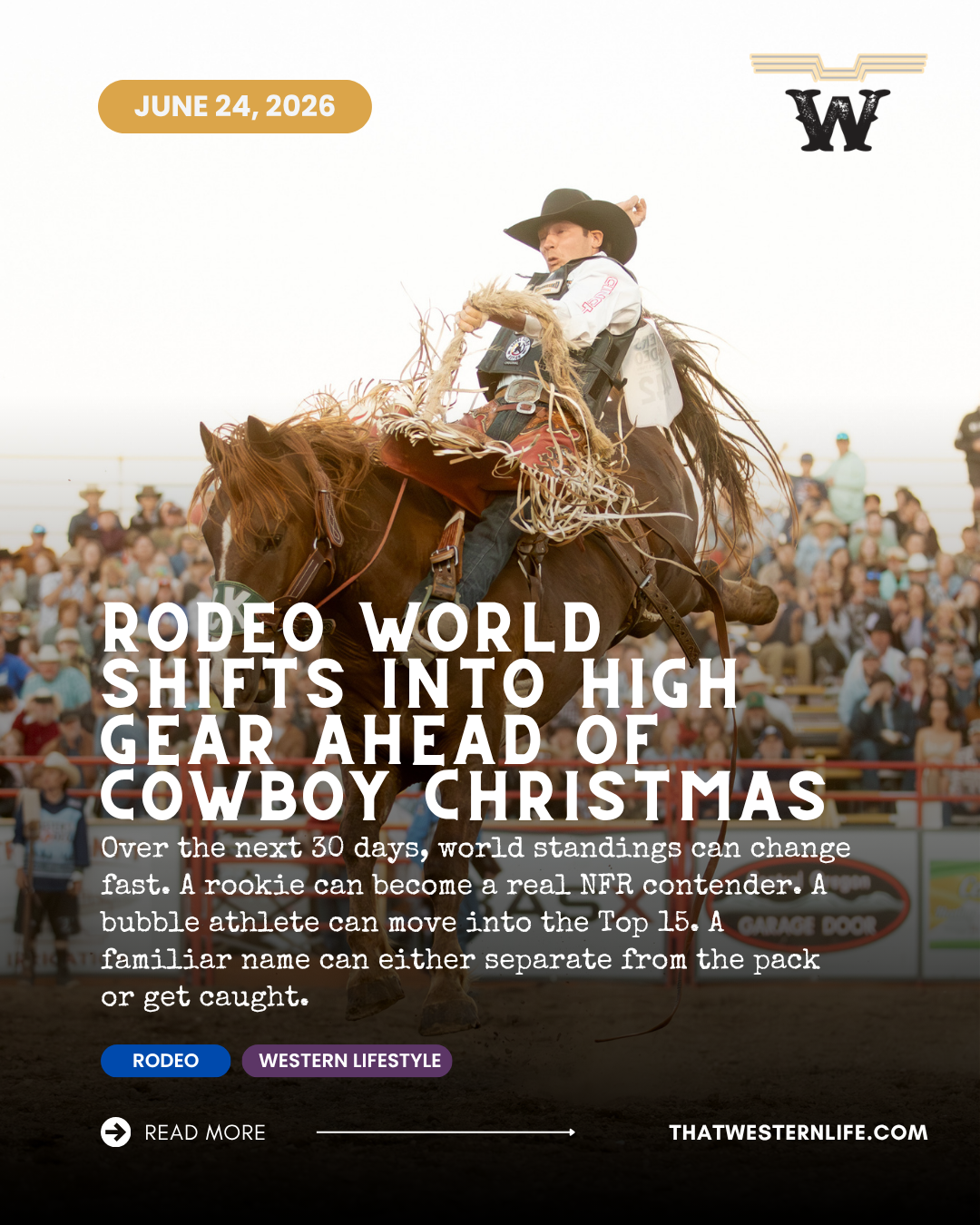
Cowboy Christmas Is Where the NFR Race Starts to Get Expensive
Cowboy Christmas is almost here, and the rodeo world is about to hit one of the most important stretches of the season.
Over the next 30 days, world standings can change fast. A rookie can become a real NFR contender. A bubble athlete can move into the Top 15. A familiar name can either separate from the pack or get caught.
This is the part of the summer where rodeo storylines get made.
As major PRCA rodeos open across the country, all eyes are on who is heating up, who is holding steady, and who is about to make the kind of run that changes their season.
That Western Life will be watching the names moving up, the rodeos that matter, and the stories behind the standings.
Because in rodeo, July does not just pay well.
It decides a lot.
That point usually arrives somewhere between late June and the Fourth of July.
In rodeo, they call it Cowboy Christmas. The name sounds charming, almost quaint, like a dusty holiday built around truck stop coffee, fireworks, and a stack of entry confirmations. In reality, it is one of the most economically consequential stretches of the professional rodeo season.
For roughly ten days, contestants can run at a concentration of high-paying rodeos that rarely exists anywhere else on the calendar. Greeley. Ponoka. St. Paul. Cody. Prescott. Livingston. Red Lodge. Oakley City. Molalla. Belle Fourche. Basin City. Benalto. And a long list of smaller but strategically useful rodeos that can turn one good week into a season-altering swing.
This is not just the busy part of the year.
This is the part where the math starts to get serious.
The NFR Cutline is not a feeling. It is a number.
The National Finals Rodeo takes the Top 15 in each event at the end of the regular season. That phrase, “Top 15,” gets used so often t can lose its weight. But the number required to get there is substantial.
Heading into the 2025 National Finals Rodeo, the No. 15 cutoff in major PRCA/WPRA events generally landed between about $100,000 and $145,000 in regular-season earnings. The low end was breakaway roping, where No. 15 Macy Young entered with $100,028. Steer wrestling’s No. 15, Gavin Soileau, entered with $105,899. Team roping headers and heelers were just above that, at $114,736 and $111,672, respectively. Tie-down roping required $126,957. Bareback riding required $129,951. Bull riding required $138,918. Saddle bronc riding was the highest of this group, with No. 15 Lefty Holman entering at $144,872. Barrel racing’s published 2025 field showed Katelyn Scott in the No. 15 position with $130,763.
Put another way: across those nine NFR event categories, the 2025 average No. 15 threshold was roughly $122,644.
That is the number Cowboy Christmas begins to chase.
A contestant who wins $25,000 to $35,000 over the Fourth of July run has not merely had a good week. They may have banked 20% to 30% of what it took, on average, to make the NFR in 2025.
That is why this stretch matters.
Why the Fourth of July pays differently
The rodeo economy is not evenly distributed.
There are rodeos that matter because of prestige. There are rodeos that matter because of history. There are rodeos that matter because of geography - don’t forget, contestants are still battling for year-end circuit finals as well. And then there are rodeos that matter because the checks are large enough to alter a contestant’s season in one trip.
Cowboy Christmas is where all of those things stack.
St. Paul Rodeo in Oregon says contestants compete for nearly $500,000 in prize money, with top competitors taking home individual winnings as large as $10,000. Cody Stampede, according to the ProRodeo Hall of Fame, draws 800-900 contestants and has a payout of more than $400,000, while also being a one-header rodeo, which means contestants can compete once and keep moving. Greeley Stampede has recently been reported as paying more than $400,000 as well. Ponoka Stampede’s format can produce large individual outcomes, especially through its finals and showdown structure.
That structure is why Cowboy Christmas is not only about talent. It is about logistics.
A contestant has to draw well, compete well, drive all night, manage horses, manage injuries, hit the right set of rodeos, and make the kind of decisions that do not show up in a results sheet. Do you chase the biggest check? Do you take the rodeo that fits your horse? Do you skip a rodeo to keep one fresh? Do you enter a smaller stop because it is on the route and the odds are better?
The standings reward money. But Cowboy Christmas tests judgment.
The case studies
Halyn Lide
In 2024, barrel racer Halyn Lide became a clean example of what this stretch can do.
Lide was the highest-earning barrel racer over Cowboy Christmas, with reported earnings of roughly $32,550 across the Fourth of July run. Her money came from major stops including Ponoka, Greeley, and Oakley, Utah. She won Greeley and Oakley, and also picked up a go-round win at Ponoka.
The result was not just a good week. It changed the way people talked about her season.
By late November, The Cowboy Channel framed Lide as a first-time NFR qualifier and pointed back to her Cowboy Christmas earnings as a major piece of that climb. That is the function of this run: it turns “watch her” into “she is in the race.”
For fans, that is the moment to pay attention. Not in December, when the back numbers are already assigned. In July, when a contestant starts putting pressure on the bubble.
Emily Beisel
Emily Beisel offers the veteran version of the same story.
In 2024, Beisel finished just behind Lide among Cowboy Christmas barrel racing earners, with $30,211. The breakdown is the important part: $17,460 at Ponoka, $11,086 at St. Paul, and $1,665 at Red Lodge.
That kind of week does two things. First, it moves money into the standings quickly. Second, it confirms a competitor’s summer strategy.
Beisel was not an unknown name. She was already one of the sport’s proven winners. But Cowboy Christmas can serve veterans differently than rookies. For a new name, it creates attention. For a veteran, it creates separation.
In a season where the No. 15 barrel racing cutoff was around $130,000 the following year, a $30,000 Fourth of July run represents nearly a quarter of that benchmark.
That is not momentum as a metaphor. That is momentum as arithmetic.
Riley Webb
Tie-down roper Riley Webb delivered the 2025 version.
Webb reportedly won $32,537 during Cowboy Christmas 2025, with checks at Cody, St. Paul, Killdeer, Basin City, Livingston, and Greeley. The largest piece came from St. Paul, where he won $16,235. He also added $5,090 at Basin City, $4,599 at Greeley, and $4,376 at Cody.
Compare that to the 2025 NFR tie-down roping cutoff: Shane Hanchey entered the NFR at No. 15 with $126,957. Webb’s Fourth of July run alone was equal to roughly 25.6% of that threshold.
That is the scale of the opportunity.
A single week cannot make an NFR season by itself. But a week like that can change the pressure of every rodeo that follows. It can move a contestant from chasing the bubble to defending a position. It can make a sponsor notice. It can make media start writing the name differently. It can make every check in August and September feel like a step toward Las Vegas rather than a rescue mission.
What fans should watch
Cowboy Christmas is not only about who wins the famous rodeos. Sometimes the more interesting story is who places everywhere.
A roughstock rider who wins one major rodeo can make a leap. A timed-event contestant who places at five stops may do even more damage. A barrel racer who gets through Ponoka, Greeley, St. Paul, and a smaller rodeo with clean runs can suddenly become impossible to ignore.
The names to watch are not only the world No. 1s. They are the contestants sitting from roughly No. 12 to No. 25 in the standings before the run begins.
That is the volatile zone.
A contestant already inside the Top 10 can use Cowboy Christmas to build distance. A contestant sitting just outside the Top 15 can use it to break in. A rookie can use it to become a storyline. A veteran can use it to remind everyone that summer rodeo is not won by hype, but by cashing checks in places most fans only see as dots on a map.
Why this matters for rodeo media
For That Western Life, Cowboy Christmas is exactly the kind of stretch that deserves more attention.
Rodeo coverage often gets loudest when champions are crowned. But the more interesting story often starts earlier, when the standings are still unsettled and the sport has not yet agreed on who matters.
This is where the NFR race begins to sharpen.
This is where unknown names become dangerous.
This is where good horses become famous.
This is where a contestant can go from “having a decent year” to “we need to talk about them.”
And this is where fans can learn to watch rodeo differently.
The Fourth of July run is not just a holiday tradition. It is a market correction. It rewards the contestants who can win, travel, manage risk, and keep performing when the sport asks the most from them in the shortest window.
By the time December arrives, the NFR field can feel inevitable.
In July, it is still being built.

The 2022 National Finals Rodeo by State
The 2022 National Finals Rodeo is quickly approaching and we thought we’d take a dive into where our 2022 Contestants are from state-by-state!
The 2022 National Finals Rodeo is quickly approaching and we thought we’d take a dive into where our 2022 Contestants are from state-by-state!

Texas
Barrel Racing (8): Jordon Briggs (Tolar, TX) | Stevi Hillman (Granbury, TX) | Hailey Kinsel (Cotulla, TX) | Shelley Morgan (Eustace, TX) | Sissy Winn (Chapman Ranch, TX) | Kassie Mowry (Dublin, TX) | Bayleigh Choate (Fort Worth, TX) | Brittany Pozzi Tonozzi (Lampasas, TX)
Tie-Down Roping (7): John Douch (Huntsville, TX) | Caleb Smidt (Bellville, TX) | Tuf Cooper (Decatur, TX) | Cory Solomon (Prairie View, TX) | Marty Yates (Stephenville, TX) | Ty Harris (San Angelo, TX) | Kincade Henry (Mount Pleasant, TX)
Team Roping (6): Tanner Tomlinson (Angleton, TX) | Tyler Wade (Terrell, TX) | Lightning Aguilera (Athens, TX) | Buddy Hawkins (Stephenville, TX) | Patrick Smith (Lipan, TX) | Wesley Thorp (Throckmorton, TX)
Steer Wrestling (1): Hunter Cure (Holliday, TX)
Bull Riding (2): Jeff Askey (Athens, TX) | Maverick Potter (Waxachie, TX)
Saddle Bronc (1): Wyatt Casper (Miami, TX)
Bareback (4): Rocker Steiner (Weatherford, TX) | Leighton Berry (Weatherford, TX) | Cole Franks (Clarendon, TX) | Tilden Hooper (Carthage, TX)
Oklahoma
Barrel Racing (4): Dona Kay Rule (Minco, OK) | Wenda Johnson (Pawhuska, OK) | Emily Beisel (Weatherford, OK) | Leslie Smalygo (Skiatook, OK)
Tie-Down Roping (4): Clay Smith (Broken Bow, OK) | Joseph Harrison (Marietta, OK) | Tyler Milligan (Pawhuska, OK) | Hunter Herrin (Apache, OK)
Team Roping (4): Andrew Ward (Edmond, OK) | Coleman Proctor (Pryor, OK) | Travis Graves (Jay, OK) | Brye Crites (Welch, OK)
Bull Riding (3): Trevor Kastner (Roff, OK) | Trey Kimzey (Strong, OK) | Lukasey Morris (Union City, OK)
Canada
Team Roping (1): Jeremy Buhler (Arrowwood, AB)
Bull Riding (1): Jared Parsonage (Maple Creek, SK)
Saddle Bronc (6): Zeke Thurston (Big Valley, AB) | Logan Hay (Wildwood, AB) | Layton Green (Millarville, AB) | Kolby Wanchuk (Sherwood Park, AB) | Kole Ashbacher (Arrowwood, AB) | Dawson Hay (Wildwood, AB)
Bareback (1): Orin Larsen (Inglis, MB)
Montana
Tie-Down Roping (1): Haven Meged (Miles City, MT)
Team Roping (1): Clay Tryan (Billings, MT)
Steer Wrestling (2): Ty Erickson (Helena, MT) | Timmy Sparing (Helena, MT)
Saddle Bronc (2): Sage Newman (Melston, MT) | Chase Brooks (Deer Lodge, MT)
Bareback (1): Caleb Bennett (Corvallis, MT)
Kansas
Tie-Down Roping (1):
Team Roping (1): Jake Long (Coffeyville, KS)
Steer Wrestling (1): Tanner Brunner (Ramona, KS)
Bull Riding (2): Trey Holston (Fort Scott, KS) | JR Stratford (Byers, KS)
Bareback (1): Jess Pope (Waverly, KS)
Louisiana
Tie-Down Roping (3): Shane Hanchey (Sulphur, LA) | Zack Jongbloed (Iowa, LA) | Macon Murphy (Keatchie, LA)
Steer Wrestling (3): Tyler Waguespack (Gonzales, LA) | Tristan Martin (Sulphur, LA) | Rowdy Parrott (Mamou, LA)
Idaho
Steer Wrestling (2): Stetson Jorgensen (Blackfoot, ID) | Dirk Tavenner (Rigby, ID)
Bull Riding (2): Garrett Smith (Rexburg, ID) | Tristen Hutchings (Monteview, ID)
Saddle Bronc (1): Kade Bruno (Challis, ID)
California
Team Roping (1): Cody Snow (Los Olivios, CA)
Saddle Bronc (1): Lefty Holman (Visalia, CA)
Bareback (2): R.C. Landingham (Hat Creek, CA) | Clayton Biglow (Clements, CA)
South Dakota
Barrel Racing (2): Jessica Routier (Buffalo, SD) | Lisa Lockhart (Oelrichs, SD)
Team Roping (2): Jr. Dees (Aurora, SD) | Levi Lord (Sturgis, SD)
Utah
Team Roping (1): Rhen Richard (Roosevelt, UT)
Bull Riding (2): Stetson Wright (Milford, UT) | Josh Frost (Randlett, UT)
Saddle Bronc (2): Stetson Wright (Milford, UT) | Ryder Wright (Beaver, UT)
Bareback (1): Kaycee Feil (Genola, UT)
Wyoming
Saddle Bronc (2): Brody Cress (Hillsdale, WY) | Tanner Butner (Daniel, WY)
Bareback (1): Cole Reiner (Buffalo, WY)
Minnesota
Steer Wrestling (1): J.D. Struxness (Milan, MN)
Bull Riding (1): Reid Oftedahl (Raymond, MN)
Bareback (1): Tanner Aus (Granite Falls, MN)
Florida
Barrel Racing (1): Margo Crowther (North Fort Myers, FL)
Team Roping (2): Dustin Equsquiza (Marianna, FL) | Jonathan Torres (Ocala, FL)
Mississippi
Team Roping (1): Jake Orman (Prairie, MS)
Steer Wrestling (1): Will Lummus (Byhalia, MS)
Nevada
Team Roping (1): Jade Corkill (Fallon, NV)
Steer Wrestling (1): Dakota Eldridge (Elko, NV)
Washington
Team Roping (2): Riley Minor (Ellensburg, WA) | Brady Minor (Ellensburg, WA)
New Mexico
Tie-Down Roping (1): Shad Mayfield (Clovis, NM)
Team Roping (1): Logan Medlin (Tatum, NM)
North Dakota
Bareback (1): Ty Breuer (Mandan, ND)
Nebraska
Bareback (1): Garrett Shadbolt (Merriman, NE)
Iowa
Bareback (1): Tim O’Connell (Zwingle, IA)
Missouri
Bull Riding (2): Creek Young (Rogersville, MO) | Cole Fischer (Jefferson City, MO)
Australia
Bull Riding (1): Ky Hamilton (Mackay, QL)
Wisconsin
Steer Wrestling (1): Nick Guy (Sparta, WI)
Oregon
Steer Wrestling (1): Jesse Brown (Baker City, OR)
Alabama
Steer Wrestling (1): Kyle Irwin (Roberstdale, AL)
Tennessee
Team Roping (1): Chad Masters (Cedar Hill, TN)
Georgia
Team Roping (1): Kaleb Driggers (Hoboken, GA)
Colorado
Team Roping (1): Trey Yates (Pueblo, CO)
Brazil
Team Roping (1): Junior Nogueira (Presidente Prudente, SP)


Calgary Stampede is ON for 2021!
April 5, 2021 (Alberta, Canada) - The National Post announced last week that not only is the Calgary Stampede back on for 2021, but that a private member’s bill passed unanimously in the Canadian legislature to make rodeo the province’s official sport.

Ivy Conrado-Saebens makes a barrel racing run on her mare, JLo, at the 2019 Calgary Stampede. In Alberta, one of the early, major blows of the COVID-19 pandemic was the cancellation of the Calgary Stampede in 2020. PHOTO BY AZIN GHAFFARI/POSTMEDIA/FILE
April 5, 2021 (Alberta, Canada) - The National Post announced last week that not only is the Calgary Stampede back on for 2021, but that a private member’s bill passed unanimously in the Canadian legislature to make rodeo the province’s official sport. With large agricultural routes, rodeo is thought to have arrived in Calgary via a spillover of the American West.
The Calgary Stampede is one of the five largest rodeos in the world and the province of Alberta was hit hard when they had to cancel in 2020 due to the COVID-19 pandemic. As they move towards the 2021 event, perhaps modified as many other rodeos are forcing to do, it’s a relief to see rodeo return to the rural communities who rely on them economically.

Trippy Dip - Who is the Thoroughbred inducted into the 2018 AQHA Hall of Fame?
The American Quarter Horse Association is the largest nationally recognized breed registry in the world and one of the greatest honors that a member or an animal can receive is induction into their Hall of Fame. In the announcement of the 2018 class of inductees, one name stands out: Trippy Dip. A 1976 Thoroughbred, how did this lone wolf get into the QUARTER HORSE Hall of Fame?
May 31st, 2018 - The American Quarter Horse Association is the largest nationally recognized breed registry in the world and one of the greatest honors that a member or an animal can receive is induction into their Hall of Fame. In the announcement of the 2018 class of inductees, one name stands out: Trippy Dip.
A 1976 Thoroughbred, how did this lone wolf get into the QUARTER HORSE Hall of Fame?
Born in 1976, Trippy Dip was bred by S.F. Henderson of Odessa, Texas and earned $78,169 on the track. Labeled as the "definition of a broodmare," she went on to produce sixteen foals. These foals have had an impact that has trickled down the ranks of not only the racetrack, but also the barrel horse world. Fifteen of Trippy Dip's foals went on to earn a total of $1.757 million dollars on the track. Of those fifteen, seven of them earned "black type," a racing term that means a horse has won or placed in a select race of importance meaning that on their race form or sale catalog, they would be printed in bold black ink in capital letters.
Noteworthy Foals

Calyx
Calyx
The first foal of Trippy Dip's was a stallion named Calyx who was the world champion 1987 distance horse where he set the track record at Los Alamitos for 870 yards at 44.420 seconds. An outlaw through and through, he was dominant on the track and sired foals who grossed over $7 million on the track.
In a story from one of his jockey's, "Diamond Jim" Brooks, he explains how you couldn't touch his mouth, he was his own operator and he knew exactly what to do to win. With a speed index of 117, winning is what Calyx did and he passed that trait down to his offspring. Winning was also something that his sire, Dash for Cash did as well.


Florentine
The 1984 daughter of Trippy Dip was another iconic cross with the legendary stallion Dash for Cash. In her three year stint as a racehorse, Florentine won $1,123,102, and was named the Champion Three-Year-Old Filly in 1987, the Champion Aged Horse and Champion Aged Mare in 1988.
Her contributions to the world of fast sprinting horses didn't stop with her wins, Florentine went on to be named the 1996 Broodmare of the Year and earned a recognition as a dam of distinction.
Owned by Rainbow Glass Ranch, this mare's foals went on to do big things in the arena.
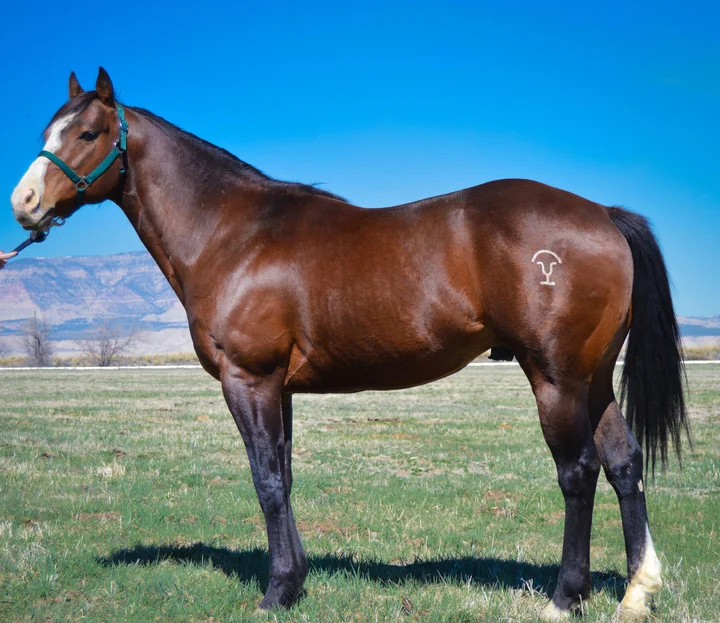
There are numerous other colts and fillies that were produced by this legendary racehorse in her broodmare career, more than we can fill into one short article. Please read more about the other inductees into the 2018 American Quarter Horse Association Hall of Fame here. As well as check out the Rainbow Glass Ranch in Utah who stands numerous offspring at stud still.
Do you ride an offspring of Trippy Dip? If so, comment below and share with us a picture of your running bred horse!

Tiany Schuster 'Bumped' From #1 Back Number Spot
Only three cowgirls have ever held the elusive number one position. Those three cowgirls that have held the number one back number are Mary Burger, Sherry Cervi, and Charmayne James. It was assume that the 2017 Wrangler National Finals Rodeo would be the inclusion of a fourth cowgirl to earn the number one back number: Tiany Schuster of Texas. Fans thought wrong.
Las Vegas, Nevada (October 25, 2017) - The much anticipated back numbers were released for the 2017 Wrangler National Finals Rodeo held in Las Vegas at the beginning of December. Excitement for the official listing of the WNFR back numbers is to find out "who will be number 1?" The back numbers are based upon the amount of money earned towards the finals, with both cowboys and cowgirls competing for that elusive spot.
Only three cowgirls have ever held the elusive number one position. Those three cowgirls are Mary Burger, Sherry Cervi, and Charmayne James. It was assumed that the 2017 Wrangler National Finals Rodeo would be the inclusion of a fourth cowgirl to earn the number one back number: Tiany Schuster of Texas.
Fans thought wrong.
The reason this number is so minimal is because the odds are stacked against them as cowgirls are technically only eligible to compete in one event in the Professional Rodeo Cowboys Association (girls barrels), which is co-sanctioned through the Women's Professional Rodeo Association. Cowboys, however, are eligible to compete in any of the seven other events, as well as all around monies won.
In a record setting season, Tiany was as much as $100,000 ahead of her second place competitor in her event. Hot on the pursuit, it was her goal for that number one back number and to be only the fourth cowgirl to hold the position.
So on October 25th, when the listing was created, the social world was inspired by the move of the PRCA to reserve the number 58 back number for the 58 victims of the mass killing at a Las Vegas country music concert. An honorable move, it may have proved for enough of a distraction from some other peculiar on the back number standings.
- Tuf Cooper (All Around, Calf Roping, Team Roping, Steer Roping)
- Tim O'Connell (Bareback)
- Trevor Brazile (All Around, Calf Roping, Team Roping, Steer Roping)
- Jacobs Crawley (Saddle Bronc)
- Tiany Schuster (Girls Barrels - WPRA Co-Sanctioned)
In a strange mix of events, the PRCA took the monies won at Calgary (Canada), Houston (Texas), and the WPRA Finals money off all the girls' totals. They also took the money won at Xtreme Bulls events (the PRCA's version of the PBR) off the bull riders' totals.
In a post on Facebook, Schuster addressed the problem, stating:
"Ya know perhaps that money shouldn't count. Fine. But don't change the way things have always been awarded and done... Yeah I busted my butt and stayed out there, thinking I was ahead. I was not very happy when I got that, 'Oh by the way...' phone call TWO days before the end of the season. Why wait to the last minute? Why was this such a big secret and why the last second change of venue? No one will answer those questions. It is the 11th year of the 10 year contract. Lots of changes. Just saddens me to know that no matter what, WPRA members have no ground to stand on because we are 'invited guests.' Y'all want to talk about all the woulda shoulda coulda money if it all counted, it would be over $325,000 and there is NO American money for me. ...now we know, don't ever expect something because it will, inevitably, be taken from you. Lots of girls worked hard for rankings. Not just me. To only have it taken from them as well. State flags won't get to be carried, while others moved to the end of the list.... but life goes on... actions speak louder than words and numbers don't lie."
The reason for not counting rodeos like Calgary or Houston is because they don't have team roping at the event, putting those competitors at odds in the final count for the back number race. With that being said, this should have been known information at the start of the season, not with a few days left in the end.
After all of this, Schuster's fire should be burning more than ever and, if she's firing on all cylinders like she did with her arena-record setting performance in Calgary, she will be putting in quite a performance at Wrangler National Finals Rodeo.
**REVISED UPDATE**OCTOBER 27, 2017**
Released from the Women's Professional Rodeo Association on October 26, 2017.

###
That Western Life is a news media company focused on bringing the latest news in the rodeo, ranching, agriculture, agvocacy and western lifestyle to those interested. Join our mailing list today to be updated and follow us on all social media platforms. The opinions expressed on this site are that of the authors alone and do not represent That Western Life or Western Insights Media.
Cover photo taken and owned by the Calgary Sun (Canada).