
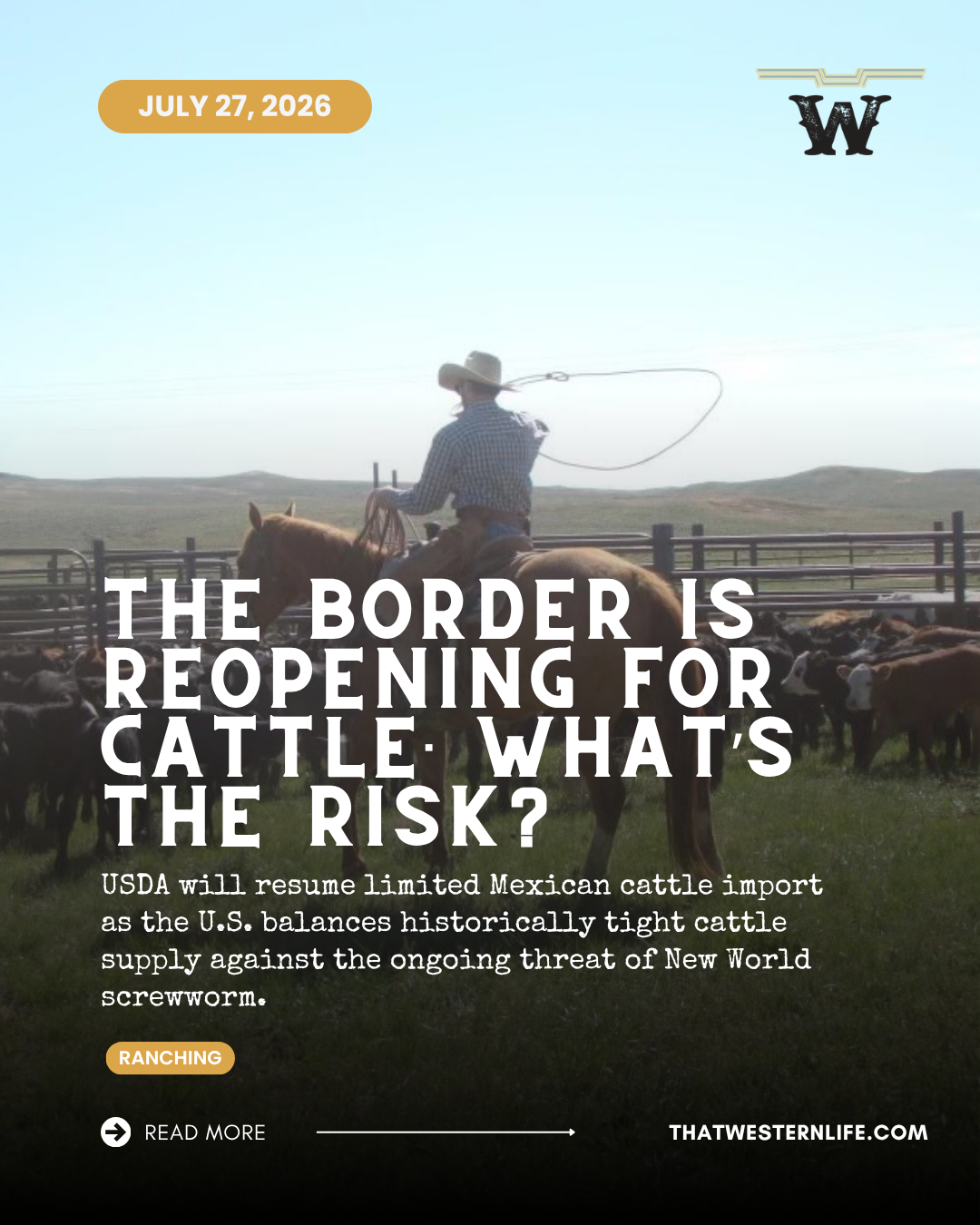
Reopening the Mexican Cattle Border Forces USDA to Balance Beef Supply Against Biological Risk
The United States needs more cattle—but it cannot afford to underestimate New World screwworm.
USDA plans to reopen the Douglas, Arizona, port to Mexican livestock on August 24, beginning a phased return to cross-border cattle trade. Feedlots and processors see additional cattle as welcome relief for a historically tight supply chain. Many domestic ranchers, however, are asking whether trade should resume while the parasite remains active on both sides of the border.
And this isn’t a simple ranchers-versus-regulators debate.
USDA’s decision to resume limited cattle imports from Mexico places two agricultural priorities into direct conflict. The United States needs more cattle moving through its feeding and processing system, but it also needs to prevent New World screwworm from becoming permanently reestablished across its livestock-producing regions.
Beginning August 24, 2026, USDA plans to reopen the port at Douglas, Arizona, to Mexican cattle. The agency will then consider reopening ports at Santa Teresa and Columbus, New Mexico, after evaluating the initial results and any change in biological risk. This is not a return-to-normal trade. It is a controlled test of whether cattle commerce can resume while a dangerous livestock parasite remains active in both Mexico and the United States.
What the USDA is proposing
The reopening is conditional on Mexico meeting milestones established under a bilateral Joint Action Plan. Every animal entering through an approved port will receive a USDA inspection for signs of New World screwworm. USDA says Sonora and Chihuahua are currently Mexico’s lowest-risk states because of their established animal-health infrastructure, inspection programs, and distance from the heaviest concentration of cases in southern Mexico.
The first port, Douglas, borders Sonora. When the USDA announced the plan on July 24, the closest active Mexican case was approximately 325 miles from the crossing. After reviewing the Douglas reopening, the Animal and Plant Health Inspection Service may authorize cattle, bison, and horses to enter through the two New Mexico ports. USDA has not committed to firm reopening dates for those crossings.
The agency also retains the authority to slow ro suspend the process if audits, surveillance, or new detections indicate that conditions have deteriorated.
“The closure of the Southern ports of entry for the last year has been a tough but necessary action,” Agriculture Secretary Brooke Rollins said while announcing the plan. USDA now believes the Douglas crossing can reopen safely, provided Mexico continues meeting the agreement’s requirements (read more).
The USDA is not declaring that the screwworm threat has been eliminated; it is arguing that the risk can now be managed.
Why the cattle supply matters
The economic argument for reopening begins with the size of the American cattle herd. As of January 1, 2026, the United States had 86.2 million cattle and calves, including 27.6 million beef cows. The estimated 2025 calf crop fell 2%, while cattle on feed declined 3% (USDA National Ag Statistics Service). Those figures reflect a contraction that began before the latest border closure. Drought, high production costs, poor pasture conditions, and years of herd liquidation all contributed to the shortage. It would therefore be too simplistic to blame record beef prices primarily on the interruption of Mexican cattle imports.
The border closure made an already tight market tighter, but it did not create the underlying cattle cycle.
Mexico traditionally supplies most of the live cattle imported into the United States. From 2020 through 2024, it accounted for approximately 62% of U.S. cattle imports. Nearly all were lighter-weight animals destined for American stocker and feeder operations, rather than cattle entering immediately for slaughter (USDA Economic Research Service). This is why Mexican cattle are strategically important, even though they remain a relatively small share of the total U.S. herd.
Feedlots need animals to fill pens. Packers need finished cattle to keep plants operating efficiently. When fewer feeder cattle are available, feedlots compete more aggressively for replacements. That pressure eventually reaches processors and then retailers.
By June 2026, the national average price of conventional ground beef had reached $6.83 per pound, approximately 11.5% higher than 2025. We covered this story as part of our 4th of July ranching article HERE.
Reopening the border could add animals to that constrained system. However, it will not quickly reverse retail beef inflation. These are feeder cattle, not boxed beef ready for a grocery case. They must be inspected, transported, fed to market weight, and processed. A limited reopening through one port also cannot replace several years of domestic herd contraction.
The most immediate effects are more likely to appear in feeder-cattle availability, feedlot occupancy, and processor procurement - not in a sudden reduction at the meat counter.
Feedlots and processors support reopening
The organizations most directly dependent on cattle throughput have generally welcomed the USDA’s decision. The Meat Institute, which represents meat and poultry processors, supports what President and CEO Julie Anna Potts called “a careful, phased reopening” that combines vigilance with confidence in the government’s response plan.
“Importing cattle from Mexico allows beef packers to better meet consumer demand given the tight supply of U.S. cattle,” Potts said for Reuters.
The Texas Cattle Feeders Association reached a similar conclusion. Its leadership argues that the closure gave USDA time to strengthen its surveillance, treatment, and response protocols, and that the science now supports limited trade. through lower-risk ports.
For feedlots, the economic reasoning is straightforward. Empty pen space earns nothing. More feeder cattle allow existing feeding and processing infrastructure to operate closer to capacity. That doesn’t necessarily mean every cattle producer benefits equally.
Ranchers do not have the same economic interest
The statement “the United States needs cattle” is broadly true, but it can conceal an important industry divide. Feedlots and processors benefit from having more cattle available. Cow-calf producers selling domestic calves have benefited from intense competition and historically strong prices. Mexican feeder cattle can relieve the supply shortage, but they also compete with U.S.-raised calves for feedlot placement.
That helps explain why reopening the border cannot simply be described as universally beneficial for “ranchers.”
The Texas & Southwestern Cattle Raisers Association supports the phased plan, but its endorsement is conditional. President Stephen Diebel said producers need both functioning commerce and assurance that “every reasonable safeguard” is being used.
The organization has also said it would urge USDA to close the ports immediately if scientific evidence indicates that the risk has changed (OK Farm Report). The National Cattlemen’s Beef Association (NCBA) also supports a gradual reopening. CEO Colin Woodall credited federal agencies and border-state producers with domestic readiness enough to begin restoring cattle movement.
These organizations are not arguing that screwworm is harmless, but that stronger surveillance, controlled entry points, inspection, and sterile-fly programs make limited trade an acceptable risk.
The opposition: inspection may not address the entire pathway
R-CALF, which represents independent cattle producers and frequently challenges policies it believes disadvantage domestic ranchers, is taking a more skeptical position. CEO Bill Bullard argues that reopening the border will encourage cattle to move north from parts of Mexico where the parasite is present.
“As long as the border is open, it will incentivize the northward movement of cattle,” Bullard told Reuters.
That criticism reaches beyond whether an individual animal appears healthy when inspected. The concern is that reopening trade changes cattle-movement patterns throughout Mexico. Animals may pass through multiple operations before reaching an approved export region. The relevant biosecurity system, therefore, begins long before cattle arrive at Douiglas, Sant Teresa, or Columbus.
An inspection at the border can detect visible wounds, larvae, or other clinical signs. It cannot, by itself, guarantee that every upstream movement was properly documented or that infected wildlife and flies are absent from the surrounding environment.
That is why USDA’s audits of Mexican surveillance and movement controls may ultimately matter as much as inspection at the port.
Why does screwworm produce such a different kind of risk
New World screwworm is not primarily a meat-safety issue. USDA has emphasized that the presence of the parasite does not mean the American food supply is unsafe. It is an animal health, wildlife, and production threat.
Female flies lay eggs on wounds or body openings of living, warm-blooded animals. The larvae then burrow into living tissue, causing severe and potentially fatal damage. Livestock, horses, pets, wildlife, and, in rare cases, people can be affected. A wound as small as a tick bite may attract a fly (USDA APHIS).
For ranchers, the list of potential entry points is extensive: newborn navels, calving injuries, castration, dehorning, branding, predator wounds, fencing cuts, and routine insect bites. The United States eradicated the parasite decades ago through surveillance and the mass release of sterile male flies. Because female screwworm flies generally mate only once, mating with a sterile male prevents viable offspring and helps collapse the population (USDA sterile-fly program).
That program remains central to the current response, but eradication requires sufficient fly production, timely distribution, rapid reporting, and the ability to control animal movement around new detections.
Mexico sees trade restoration and recognition of its control efforts
For Mexico, the closure imposed substantial costs on cattle producers who traditionally sell calves into the American feeding system. Mexican President Claudia Sheinbaum welcomed the reopening and directed state and local authorities to accelerate preparations for cattle exports. Her government presents the decision as evidence that cooperation, regional surveillance, and investment in screwworm control are producing results.
That perspective is economically understandable. The United States is Mexico’s natural and overwhelmingly important market for live cattle. A prolonged closure leaves export-quality animals inside Mexico, changes domestic cattle values, and interrupts business relationships built around cross-border production.
However, the USDA has drawn a distinction between Sonora and Chihuahua and the rest of Mexico. Its confidence rests partly on those two states’ stronger inspection and animal-movement programs - not on a conclusion that Mexico as a whole has contained the outbreak.
The question is not “open or closed”
The stronger way to evaluate this policy is not to treat border closure as perfectly safe or reopening as recklessly permissive. The border has been closed, yet the New World screwworm was still detected in the United States. As of July 24, federal reporting showed 42 confirmed U.S. cases, 41 of them in Texas and one in New Mexico. That doesn’t prove live cattle imports are safe. It does demonstrate that imported livestock are not the only possible pathway. Wildlife, flies, and unauthorized animal movement do not necessarily obey port restrictions (The Texas Tribune).
The policy question is therefore more difficult: Can regulated cattle movements through a small number of closely monitored ports be managed without materially accelerating a threat that is already present?
USDA says yes - conditionally.
Feedlots, processors, and several major cattle associations believe the new safeguards make phased trade defensible.
Independent-producer advocates warn that the reopening introduces additional movement and economic incentives before the parasite has been contained.
Mexico argues that its lower-risk northern states have earned the opportunity to resume trade.
Consumers may eventually benefit from additional cattle supplies, but they should not expect immediate relief at the grocery store.
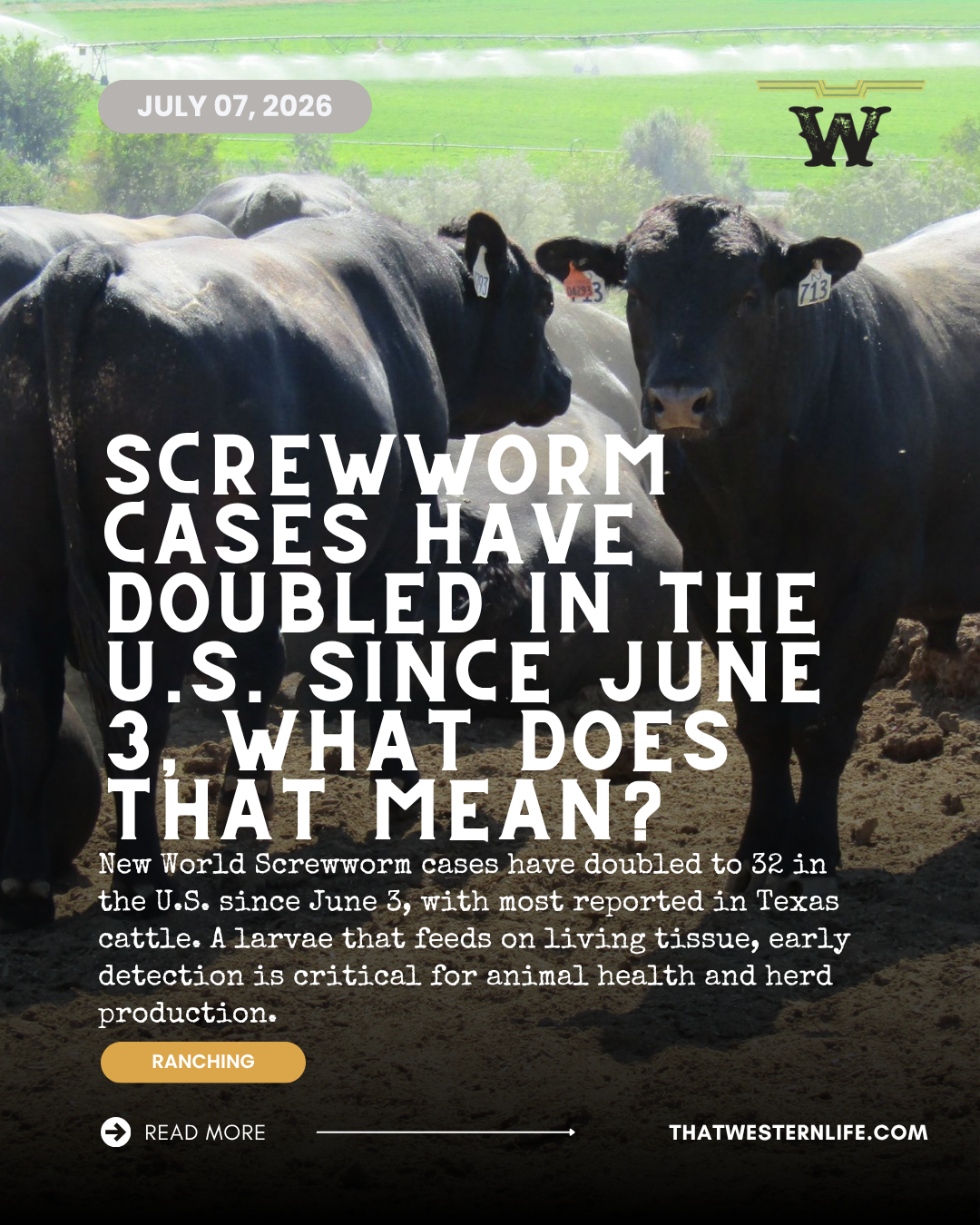
U.S. Screwworm Update: Cases Rise to 32 Since June 3 as Reports Increase Across Texas
New World screwworm cases have doubled to 32 in the U.S., with most reported in Texas cattle. These larvae feed on living tissue, making early detection critical for animal health and herd protection.
New World screwworm is no longer a distant livestock-health concern that we are protecting against; it is firmly here in the United States.
USDA has now documented 32 cases in the U.S. since June 3, with nearly all of them reported in Texas. Most of the cases have affected cattle, though infections have also been reported in sheep, goats, and dogs. Screwworm is not a routine parasite problem; it is a flesh-eating pest that can severely injure or kill livestock if it’s not caught and treated quickly.
What makes screwworm different from other parasites is how it attacks the animal
Adult flies are attracted to open wounds, even small ones like branding sites, castration cuts, tick bites, or navel areas on newborn calves. The female fly lays eggs in the wound, and within hours, those eggs hatch into larvae. Unlike typical maggots that feed on dead tissue, screwworm larvae feed on living flesh. They burrow deeper into the wound in a screw-like pattern, which is where the name comes from.
As the larvae feed, the wound becomes larger, wetter, and more painful. Ranchers may notice animals acting restless, isolating themselves, or showing signs of discomfort like tail switching, kicking at their sides, or refusing to eat. A strong, foul odor is often one of the first noticeable signs. In more advanced cases, the wound can appear deep and raw, with visible larvae moving inside it.
From an animal sciences standpoint, the damage goes beyond the surface.
The feeding activity causes tissue destruction, inflammation, and secondary bacterial infections. As the wound expands, it can lead to significant blood loss, toxemia, and systemic infection. In severe cases, especially in young, weak, or untreated animals, screwworm infestations can be fatal. Even when animals survive, weight loss, reduced performance, and long-term tissue damage can impact productivity.
The United States has faced this threat before, and the last major outbreak offers important context
Screwworm was once widespread across the southern U.S., costing the livestock industry millions of dollars each year. A coordinated eradication effort began in the 1950s using the sterile insect technique, where millions of sterilized male flies were released to disrupt reproduction. By the 1980s, the pest had been successfully eliminated from the U.S., with the exception of occasional reintroductions. One of the most notable recent incidents occurred in 2016 in the Florida Keys, where screwworm affected endangered Key deer and required an aggressive response to contain and eliminate the outbreak. That history shows both how serious the threat can become and how critical rapid response is to stopping the spread.
For ranchers, the timing is especially concerning.
The cattle industry is already dealing with tight supplies, high replacement costs, labor challenges, animal movement concerns, and elevated beef prices. A parasite outbreak adds another layer of risk. It requires more monitoring, faster treatment decisions, and stronger communication between ranchers, veterinarians, state animal-health officials, and the USDA.
This is also a labor story
During earlier eradication efforts, ranches often had more consistent labor available to check livestock closely. Today, many operations are covering more ground with fewer people. That makes surveillance harder, especially in rough country or large pastures where wounds, infestations, or wildlife exposure may not be spotted immediately.
The sterile-fly response is important, but capacity is part of the concern. The basic strategy is to release sterile flies so the wild population cannot reproduce effectively. That approach helped eliminate screwworm from the U.S. decades ago, but a modern outbreak raises questions about whether current production and response systems can move fast enough.
The takeaway is simple: livestock health is not separate from the Western economy. It is the foundation of it.
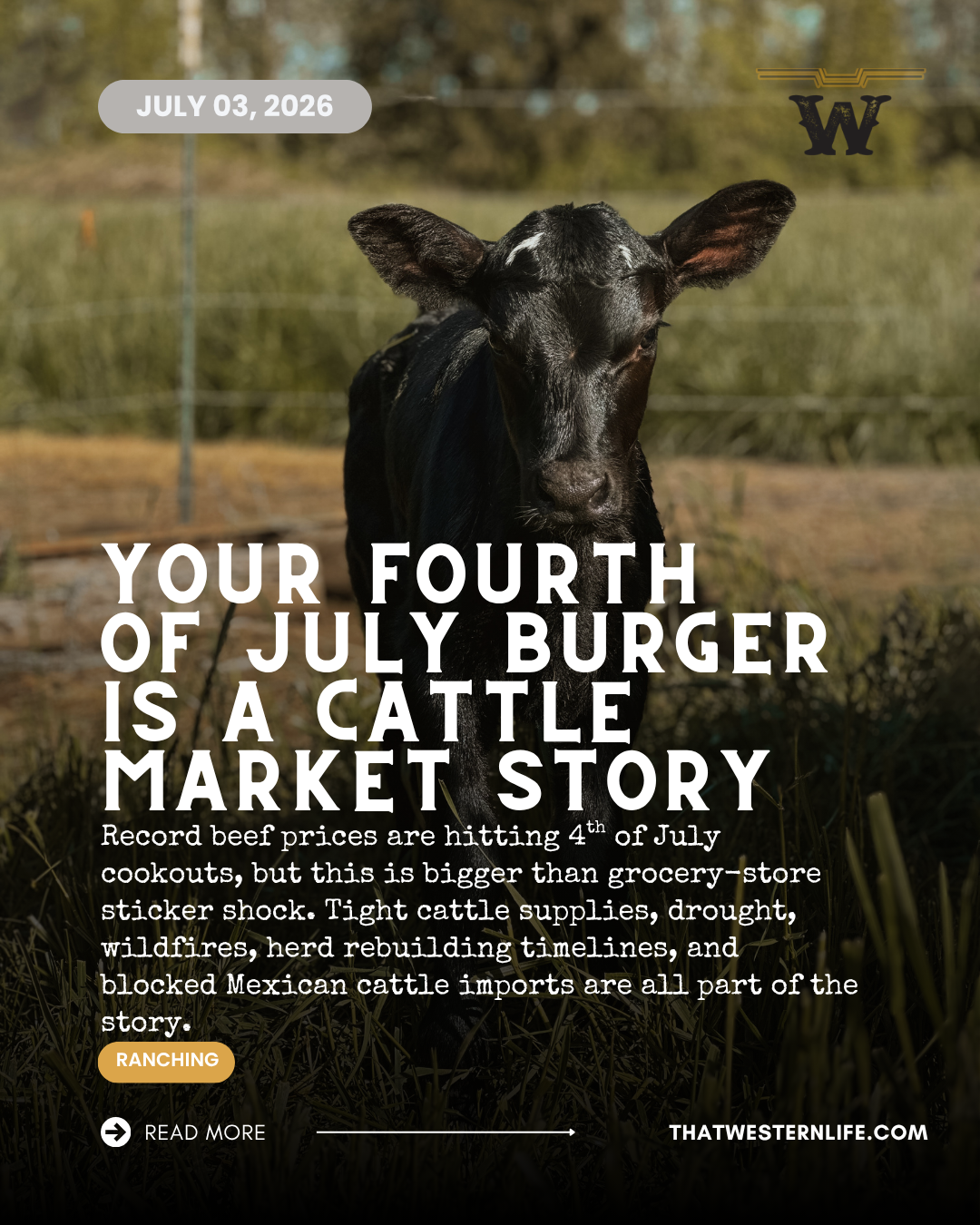
Record Beef Prices Are Turning the Fourth of July Into a Ranching Story
Record beef prices are hitting Fourth of July cookouts, but this is bigger than grocery-store sticker shock. Tight cattle supplies, drought, wildfires, herd rebuilding timelines, and blocked Mexican cattle imports are all part of the story.
This Fourth of July, the price of a hamburger is telling a much bigger story about the cattle industry.
Reuters reports that the average retail price for lean and extra-lean ground beef hit a record $8.62 per pound in May, up more than 12% from a year earlier. Wells Fargo also estimated that a barbeque for 10 people will cost $161 this year, up 2.4% from last year, with hamburger beef rising especially sharply.
For consumers, that shows up as a sticker shock.
For ranchers, it points to a deeper supply problem.
The U.S. cattle herd is still tight after years of drought, wildfire pressure, high feed costs, and difficult rebuilding conditions. When ranchers cull cows because pasture and hay are limited, the effects do not reverse quickly. Even when producers decide to retain heifers and rebuild, it takes years before those animals become part of the beef supply.
That timeline matters. Beef is not a product that can be increased overnight.
The story is also complicated by New World screwworm concerns and blocked Mexican cattle imports. When cross-border cattle movement is limited, the U.S. loses access to a supply channel that normally helps feedyards and processors. That adds pressure to an already tight domestic market.
Politically, this creates a difficult conversation. Consumers want lower beef prices. Ranchers want strong cattle prices after years of hard conditions. Policymakers may look at imports or meatpacker investigations. Producers worry that those solutions may not address the real structural issue: there are fewer cattle, and rebuilding takes time.
Elevated food prices are not just “greed” or “inflation” in a generic sense. They are tied to weather, biology, trade, disease control, land conditions, feed costs, and years of market pressure.
The Fourth of July grill is not separate from the ranch economy.
This year, it may be one of the clearest places consumers can feel the pressure the American rancher faces.

Start to Finish Breeding Services for the Beef Industry
No matter the size of the operation, the chance to boost reproductive efficiency is an opportunity any ranch can capitalize on. Thanks to start-to-finish breeding services, such as Genex and All West/Select Sires, and their professionally trained teams, ranchers are using Artificial Insemination practices and supplementation nutritional programs to take the cattle industry into the future.
Originally published in the Summer 2018 Issue of the Cattle Mag.
The ever changing impacts of today’s growing population and decreasing ranch lands has increased the pressure on ranchers to provide more product with less animals.
No matter the size of the operation, the chance to boost reproductive efficiency is an opportunity any ranch can capitalize on. Thanks to start-to-finish breeding services, such as Genex and All West/Select Sires, and their professionally trained teams, ranchers are using Artificial Insemination practices and supplementation nutritional programs to take the cattle industry into the future.
A study by the University of Georgia Extension noted that “reproductive efficiency has long been recognized as the most important aspect of commercial beef production. If only 50 percent of the cows wean a calf, crossbreeding, superior genetics and sound management become insignificant.”
The variation in a calf-crop can be the difference between profit and loss for a rancher, according to Genex’s website, a start to service breeding service business focused on member and customer profit. Not just that, but most ranchers find themselves required to send almost the entirety of their calf-crop to market in order to make their bill payments for the year. This results in a smaller number of replacement heifers kept back and slows the growth of the operation.
These breeding service operations focus on a successful re-breeding program by providing strategic supplementation to the programs that are already used on ranches.
Prices depend upon variables such as the body conditioning of cows and heifers at the time of calving, the nutrition levels of cows and heifers, and strategic breeding through the versatile bull services that AI provides.
Erin Bronson, area marketing manager of Genex Beef, explains that “inadequate nutrition will result in delayed breeding, later calving dates, and a decreased calf crop percentage. Body conditioning of a pre-calving cow will influence her post-calving feed needs, as well as her rebreeding performance.”
These services also provide an opportunity to work with a veterinarian and nutritionist to formulate a successful plan and to check the breeding-soundness of the herd bull, if you are not ready to move to a 100 percent AI program.
Breeding services operations can do as much or as little as you require of them. The amount of labor that a ranch provides during the breeding service is also up to the rancher. These businesses provide all of their own chutes, breeding barns (mobile trailers), synchronization of heifers and cows, AI arm service and more.
Ranchers can bring their own laborers to work with the breeding services team, or those hired hands can continue with their day-to-day activities. This provides the rancher with the economic benefit of not pulling labor out of other tasks, and outsourcing to professionals who are joined by a professionally trained team, proper and safe equipment, and high goals for the success of the breeding operation.
Breeding services provide an opportunity for obtaining the best genetics for your program through a catalog of national bulls to give the rancher a upper hand at refining their end goal. The desire to move to AI for many producers is that the catalog and online bulls are tested and purchased throughout the year on the best progeny that are available.
Through Genex’s online catalog, you can enter a breed or a name, and subsequently pull up a list of bulls whose genetics you can introduce into your herd based on their Expected Progeny Difference (EPD). If EPD’s are a foreign subject, a representative from one of these companies can meet to provide consultation and recommendations for the ranch.
One of the main benefits of capitalizing on a breeding service opportunity in your area, is that for the commercial producer, they are going to see a smaller calving season window that will provide a uniform weight in the cattle at market time.
Cutting down on manpower becomes an opportunity when the ranch is seeing a two week calving window versus a two to three month calving season. When it is time to go to market, these uniform calves are going to provide more weight on the truck heading to the sale yard with a smaller number of calves, allowing the ranch the luxury of holding back a larger number of replacement heifers (see infographic).
These are not free pounds, but it gives a more unified calf-crop and, if trying to fill truckloads of cattle to get to market, it’ll actually put fewer calves on the truck while still attaining the same amount of pounds.
In some scenarios, you can go from a two-axle to enough calves and pounds to put together a three-axle trailer. That weight difference is 45,000/48,000 to 63,000 (depending on location); a large gap that made up for by just getting your cows to calve at the first part of the calving season.
Breeding service companies do warn that the implementation of reproductive efficiency and AI does take a number of years before the desired goals are seen.
“If you commit to it [nutritional program, synchronization, sire selection, and AI] for a half-decade, the number of heifers and cows bred in the first week will increase as cows are consistently being bred earlier,” explained Clint Sexson of All West/Select Sires.
There are a variety of added benefits to using a breeding service that might not initially come to mind. Specifically in the northwest United States, due to the nature of the regions’ ranching systems with the combination of Forest Service permits, BLM permits, and common lands (where neighbors share permits), ranchers have an increasing importance to not take bulls out onto their permits.
If the ranchers can synchronize cows and AI early, they can have somewhere between 50 to 60 days before they have to move the herd to the permits where they are grazing in common without the bulls.
From a health and reproductive management perspective, this lowers the risk for reproductive diseases, as well as lowers the amount of labor it takes to bring in bulls from out of the country during intense heat. With cows and heifers calving earlier, this also provides larger calves to travel to the permits. For example, a calf that is 45-days-old-when turned out onto range will be a lot better off than one that is 21-days-old.
The costs of breeding AI can be substantially cheaper, not only when looking at labor and cost during breeding season, but in the cost of day-to-day owning a bull. A premiere bull sold at a bull sale could go as high as $750,000 for the top genetics.
AI provides a more affordable cost at roughly $45 to $55 per synchronized female which includes synchronization drugs, semen, and arm service, with the biggest variable being the cost of the semen straw.
Costs depends on the ranchers’ background in AI, but the more that the ranchers learn, either from workshops or the breeding service team, the more they can do themselves. Genex puts on periodic AI training classes that can also help cut down on future costs. Discounts for bulk and other deals can be managed by working with the business’ local representative.
As ranchers find themselves with more rigorous demands, the opportunities for growing their ranching operation and increasing profits are all available by using modern technology and proven programs available to attain a successful and lucrative efficiency.


Chico Rancher Loses Cow to Wolf Attack
December of 2011 was a trying time for ranchers in California as the infamous wolf OR-7 meandered from northeastern Oregon all the way to the border between California and Oregon. This marked the first time a wolf has been in California in 90 years. Washington and Oregon ranchers have long dealt with issues of wolf attacks on cattle and it seemed almost inevitable that it would reach Californian ranchers. On October 26th, 2017, a Lassen County rancher reported losing at least one cow to wolf attacks.
October 28, 2017 (Chico, California) - December of 2011 was a trying time for ranchers in California as the infamous wolf OR-7 meandered from northeastern Oregon all the way to the border between California and Oregon. This marked the first time a wolf has been in California in 90 years. Washington and Oregon ranchers have long dealt with issues of wolf attacks on cattle and it seemed almost inevitable that it would reach Californian ranchers. On October 26th, 2017, a Lassen County rancher reported losing at least one cow to wolf attacks.
Wally Roney of the Roney Land Cattle Co. has reported losing at least five cows to wolves but, according to the California Department of Fish and Wildlife, only one attack on October 13th has been confirmed. Roney's believes that warnings from CDFW of a GPS collared female wolf in the area of his cattle prior to the five attacks is confirmation enough.
In an e-mailed statement, CDFW Deputy Director Jordan Traverso said, “We went to great lengths to communicate with the rancher and with others in the community nearby about the presence of wolves. With this producer, we made it clear that the wolves were frequenting the site where his cows were. We offered the producer non-lethal assistance/tools. The producer declined."
The argument Roney provided against the non-lethal tools was that they would have stampeded his cattle. It seems that the only alternative that Roney can take is to move his cattle out of Lassen County; nearly 1,000 head will have to be displaced.
Ranchers in Oregon have long faced this turmoil with the Oregon Cattlemen's Association placing a 60-Day Intent to Sue against the United States Fish & Wildlife Services for their mismanagement of this predator. Washington has had similar issues with lethal takes on entire packs required such as the Smack Out Pack.
It seems that the issue has traveled from Washington to California with no sign of better management practices or a harmonious relationship between State Fish and Wildlife Services and private ranchers. One can only hope that a decision for better wolf management practices can be made quickly before the situation gets uglier than it already is.
Cover photo courtesy of National Park Services.
###
That Western Life is a news media company focused on bringing the latest news in the rodeo, ranching, agriculture, agvocacy and western lifestyle to those interested. Join our mailing list today to be updated and follow us on all social media platforms. The opinions expressed on this site are that of the authors alone and do not represent That Western Life or Western Insights Media.