
Cowboy Christmas Is Where the NFR Race Starts to Get Expensive
Cowboy Christmas is almost here, and the rodeo world is about to hit one of the most important stretches of the season.
Over the next 30 days, world standings can change fast. A rookie can become a real NFR contender. A bubble athlete can move into the Top 15. A familiar name can either separate from the pack or get caught.
This is the part of the summer where rodeo storylines get made.
As major PRCA rodeos open across the country, all eyes are on who is heating up, who is holding steady, and who is about to make the kind of run that changes their season.
That Western Life will be watching the names moving up, the rodeos that matter, and the stories behind the standings.
Because in rodeo, July does not just pay well.
It decides a lot.
That point usually arrives somewhere between late June and the Fourth of July.
In rodeo, they call it Cowboy Christmas. The name sounds charming, almost quaint, like a dusty holiday built around truck stop coffee, fireworks, and a stack of entry confirmations. In reality, it is one of the most economically consequential stretches of the professional rodeo season.
For roughly ten days, contestants can run at a concentration of high-paying rodeos that rarely exists anywhere else on the calendar. Greeley. Ponoka. St. Paul. Cody. Prescott. Livingston. Red Lodge. Oakley City. Molalla. Belle Fourche. Basin City. Benalto. And a long list of smaller but strategically useful rodeos that can turn one good week into a season-altering swing.
This is not just the busy part of the year.
This is the part where the math starts to get serious.
The NFR Cutline is not a feeling. It is a number.
The National Finals Rodeo takes the Top 15 in each event at the end of the regular season. That phrase, “Top 15,” gets used so often t can lose its weight. But the number required to get there is substantial.
Heading into the 2025 National Finals Rodeo, the No. 15 cutoff in major PRCA/WPRA events generally landed between about $100,000 and $145,000 in regular-season earnings. The low end was breakaway roping, where No. 15 Macy Young entered with $100,028. Steer wrestling’s No. 15, Gavin Soileau, entered with $105,899. Team roping headers and heelers were just above that, at $114,736 and $111,672, respectively. Tie-down roping required $126,957. Bareback riding required $129,951. Bull riding required $138,918. Saddle bronc riding was the highest of this group, with No. 15 Lefty Holman entering at $144,872. Barrel racing’s published 2025 field showed Katelyn Scott in the No. 15 position with $130,763.
Put another way: across those nine NFR event categories, the 2025 average No. 15 threshold was roughly $122,644.
That is the number Cowboy Christmas begins to chase.
A contestant who wins $25,000 to $35,000 over the Fourth of July run has not merely had a good week. They may have banked 20% to 30% of what it took, on average, to make the NFR in 2025.
That is why this stretch matters.
Why the Fourth of July pays differently
The rodeo economy is not evenly distributed.
There are rodeos that matter because of prestige. There are rodeos that matter because of history. There are rodeos that matter because of geography - don’t forget, contestants are still battling for year-end circuit finals as well. And then there are rodeos that matter because the checks are large enough to alter a contestant’s season in one trip.
Cowboy Christmas is where all of those things stack.
St. Paul Rodeo in Oregon says contestants compete for nearly $500,000 in prize money, with top competitors taking home individual winnings as large as $10,000. Cody Stampede, according to the ProRodeo Hall of Fame, draws 800-900 contestants and has a payout of more than $400,000, while also being a one-header rodeo, which means contestants can compete once and keep moving. Greeley Stampede has recently been reported as paying more than $400,000 as well. Ponoka Stampede’s format can produce large individual outcomes, especially through its finals and showdown structure.
That structure is why Cowboy Christmas is not only about talent. It is about logistics.
A contestant has to draw well, compete well, drive all night, manage horses, manage injuries, hit the right set of rodeos, and make the kind of decisions that do not show up in a results sheet. Do you chase the biggest check? Do you take the rodeo that fits your horse? Do you skip a rodeo to keep one fresh? Do you enter a smaller stop because it is on the route and the odds are better?
The standings reward money. But Cowboy Christmas tests judgment.
The case studies
Halyn Lide
In 2024, barrel racer Halyn Lide became a clean example of what this stretch can do.
Lide was the highest-earning barrel racer over Cowboy Christmas, with reported earnings of roughly $32,550 across the Fourth of July run. Her money came from major stops including Ponoka, Greeley, and Oakley, Utah. She won Greeley and Oakley, and also picked up a go-round win at Ponoka.
The result was not just a good week. It changed the way people talked about her season.
By late November, The Cowboy Channel framed Lide as a first-time NFR qualifier and pointed back to her Cowboy Christmas earnings as a major piece of that climb. That is the function of this run: it turns “watch her” into “she is in the race.”
For fans, that is the moment to pay attention. Not in December, when the back numbers are already assigned. In July, when a contestant starts putting pressure on the bubble.
Emily Beisel
Emily Beisel offers the veteran version of the same story.
In 2024, Beisel finished just behind Lide among Cowboy Christmas barrel racing earners, with $30,211. The breakdown is the important part: $17,460 at Ponoka, $11,086 at St. Paul, and $1,665 at Red Lodge.
That kind of week does two things. First, it moves money into the standings quickly. Second, it confirms a competitor’s summer strategy.
Beisel was not an unknown name. She was already one of the sport’s proven winners. But Cowboy Christmas can serve veterans differently than rookies. For a new name, it creates attention. For a veteran, it creates separation.
In a season where the No. 15 barrel racing cutoff was around $130,000 the following year, a $30,000 Fourth of July run represents nearly a quarter of that benchmark.
That is not momentum as a metaphor. That is momentum as arithmetic.
Riley Webb
Tie-down roper Riley Webb delivered the 2025 version.
Webb reportedly won $32,537 during Cowboy Christmas 2025, with checks at Cody, St. Paul, Killdeer, Basin City, Livingston, and Greeley. The largest piece came from St. Paul, where he won $16,235. He also added $5,090 at Basin City, $4,599 at Greeley, and $4,376 at Cody.
Compare that to the 2025 NFR tie-down roping cutoff: Shane Hanchey entered the NFR at No. 15 with $126,957. Webb’s Fourth of July run alone was equal to roughly 25.6% of that threshold.
That is the scale of the opportunity.
A single week cannot make an NFR season by itself. But a week like that can change the pressure of every rodeo that follows. It can move a contestant from chasing the bubble to defending a position. It can make a sponsor notice. It can make media start writing the name differently. It can make every check in August and September feel like a step toward Las Vegas rather than a rescue mission.
What fans should watch
Cowboy Christmas is not only about who wins the famous rodeos. Sometimes the more interesting story is who places everywhere.
A roughstock rider who wins one major rodeo can make a leap. A timed-event contestant who places at five stops may do even more damage. A barrel racer who gets through Ponoka, Greeley, St. Paul, and a smaller rodeo with clean runs can suddenly become impossible to ignore.
The names to watch are not only the world No. 1s. They are the contestants sitting from roughly No. 12 to No. 25 in the standings before the run begins.
That is the volatile zone.
A contestant already inside the Top 10 can use Cowboy Christmas to build distance. A contestant sitting just outside the Top 15 can use it to break in. A rookie can use it to become a storyline. A veteran can use it to remind everyone that summer rodeo is not won by hype, but by cashing checks in places most fans only see as dots on a map.
Why this matters for rodeo media
For That Western Life, Cowboy Christmas is exactly the kind of stretch that deserves more attention.
Rodeo coverage often gets loudest when champions are crowned. But the more interesting story often starts earlier, when the standings are still unsettled and the sport has not yet agreed on who matters.
This is where the NFR race begins to sharpen.
This is where unknown names become dangerous.
This is where good horses become famous.
This is where a contestant can go from “having a decent year” to “we need to talk about them.”
And this is where fans can learn to watch rodeo differently.
The Fourth of July run is not just a holiday tradition. It is a market correction. It rewards the contestants who can win, travel, manage risk, and keep performing when the sport asks the most from them in the shortest window.
By the time December arrives, the NFR field can feel inevitable.
In July, it is still being built.

ProRodeo Strategy (4/6/18): RNCFR Semi's & Finals Prep
Kissimmee, Florida (April 5, 2018) - The Ram National Circuit Finals Rodeo in Kissimmee, Florida, April 3rd through the 6th, promises to change the PRCA's World Standings. Here's some quick notes from the strategy room as we look at what the first two rounds alone potentially did to the World Standings. Please note that these standings are not official nor guaranteed 100% accuracy; they are simply observations.
More money stands to be won as the Top 8 contestants advance Sunday to a clean slate semi-finals round, which is then followed with the Top 4 advancing to the Finals round also on Sunday.
Kissimmee, Florida (April 6, 2018) - The Ram National Circuit Finals Rodeo in Kissimmee, Florida, April 3rd through the 6th, promises to change the PRCA's World Standings. Here's some quick notes from the strategy room as we look at what the first two rounds alone potentially did to the World Standings. Please note that these standings are not official nor guaranteed 100% accuracy; they are simply observations.
More money stands to be won as the Top 8 contestants advance Sunday to a clean slate semi-finals round, which is then followed with the Top 4 advancing to the Finals round.
Confused on the RNCFR? Read more here.
Bareback:
Clayton Biglow has won $6,245 with a round win at the RNCFR this weekend. This moves him from 21st in the world standings to 12th.
Reigning World Champion Tim O’Connell has won $10,992 with placings in 2 rounds of the RNCFR. This moves him from 13th to approximately 6th.
Some people didn’t move, and they are probably okay with that! Those people won money at the RNCFR in either one round or two, but are still locked into their world standing position.
Caleb Bennett - 1st
Mason Clements - 2nd
Jake Brown - 4th
Shane O’Connell - 5thSteven Dent won $1,801 and moved from 18th to approximately 16th in the world.
Columbia River Circuit Qualifier Steven Peebles has won $3,412 and has moved from 36th to approximately 25th.
Advancing to the Semi-Finals: Tim O'Connell, Clayton Bigelow, Shane O'Connell, Mason Clements, Jake Brown, Wyatt Denny, Steven Dent, and J.R. Vezain.
Steer Wrestling:
Louisiana Cowboy Jacob Talley has placed in two rounds and is sitting third in the aggregate heading to the semi-finals with $4,459 won. This moves him from 5th to approximately 2nd in the world standings.
Chason Floyd has won the most of any contestant at the Circuit Finals this weekend with $12,508 total, moving him from 18th in the world to approximately 7th.
With $6,254 in a round win, Kyle Irwin moves from 17th in the world to approximately 9th.
Jacob Shofner has moved one marker from 12th to approximately 11th in the world standings.
Billy Bugenig makes the biggest jump for the steer wrestling event in the world standings, moving from 31st to approximately 18th with $7,012 won through two rounds of the RNCFR
Advancing to the Semi-Finals: Billy Bugenig, Kyle Irwin, Jacob Talley, Beau Clark, Chason Floyd, Bridger Chambers, Blake Mindemann, Sean Santucci, and Jacob Shofner.
Team Roping:
Trey Yates moves from 12th to approximately 10th in the heeling world standings with $1,327 won.
Through the assistance of a round win and $6,254 won, Kyle Lockett moved from 26th to approximately 11th in the world standings.
Keven Daniel makes the second biggest move in the world standings of all team ropers, moving from 21st to approximately 12th in the heading, thanks to $4,738 won.
Brad Culpepper moved from 20th in the world standings to approximately 13th via $4,738 won.
The biggest move by all team ropers so far in the world standings due to the monies won at the RNCFR is header Blake Teixeira who won a round ($6,254) to move from 21st to approximately 15th.
Top 8 Advancing to the Semi-Finals: Thad Ward/Olin Pulham, Logan Olson/Matt Kasner, Andrew Ward/Reagan Ward, Clay Smith/Paul Eaves, Ty Blasingame/Trey Yates, Jesse Stipes/Jake Smith, Marcus Theriot/Clint Summers, and Dustin Bird/Chase Tryan.
Saddle Bronc:
Jacobs Crawley and Brody Cress both won money, keeping them at one and two in the world respectively. Although their positions didn’t change, Cress was able to chip away at the substantial lead seen by Crawley.
Wade Sundell moved from seventh to approximately third in the world standings by placing in both rounds of the RNCFR ($6,728).
Joey Sonnier won $6,918 between two rounds to move from 15th to approximately 10th in the world standings.
Both Ryder Wright and Taos Muncy moved approximately one placing to 13th and 12th respectively.
JJ Elshere moved from 17th to approximately 14th in the world standings.
Top 8 Advancing to Semi-Finals: Joey Sonnier III, Jacobs Crawley, Wade Sundell, Taos Muncy, Isaac Diaz, J.J. Elsewhere, Brody Cress, and Ray Hostetler.
Tie Down Roping:
Jake Pratt of Washington has moved one placing from 4th to approximately 3rd in teh world standings.
Three cowboys stayed in the same world standing spot despite winning money. Those were Tuf Cooper, Tyson Durfey, and Matt Shiozawa placing 5th, 6th and 13th respectively.
Sterling Smith moved from 9th to approximately 7th in the world standing.
Ryan Jarrett’s round win moved him from 15th to approximately 12th in the world standings.
Reno Gonzales of New Mexico’s winnings of $3,412 moved him from 30th to 22nd.
Top 8 Advancing to Semi-Finals: Seth Hall, Tyson Durfey, Tuf Cooper, Sterling Smith, Trey Young, Matt Shiozawa, Ryle Smith, and Riley Pruitt
Bull Riding:
Sage Kimzey continues to dominate in his bull riding career, winning money in both rounds of the RNCFR totaling $9,097. This brought him over the $100,000 mark which is the fastest he’s ever reached it in a season he mentioned in an interiview with the PRCA.
Parker Breding of Montana won a round of the RNCFR to move from 5th to approximately 2nd in the world standings.
Chase Dougherty of Oregon may have been a rookie a year ago, but he’s no rookie in 2018; he’s won $3,601 to move from 16th to 12th in the world.
Brady Portenier has won $2,843 to move from 23rd to approximately 20th.
Jeff Bertus makes the biggest jump of the bull riders, winning $2,464 to move from 50th in the world standings to 39th.
Top 8 Advancing to Semi-Finals: Sage Kimzey, Aaron Williams, Parker Breding, Brady Portenier, Chase Dougherty, Lon Danley, Dayton Swearingen, and Jeff Bertus.
Barrel Racing:
Top 8 Advancing to Semi-Finals: Shelly Anzick, Teri Bangart, Taci Bettis, Jessica Routier, Alexis Baratka, Brittany Pozzi Tonozzi, Nikki Hansen, and Kathy Petska.
###
These are just observations noted by the information provided on ProRodeo.com; these numbers are not official nor considered accurate.
Understanding ProRodeo's Circuits and the RNCFR
The Professional Rodeo Cowboys Association is organized in a slightly complicated fashion into circuits and tours that can be very confusing to those who have no idea about the road to the Wrangler National Finals Rodeo. Let's dedicate an article towards the 12, now 13, regional circuits of the PRCA, their respective circuit finals, and the qualifications to the Ram National Circuit Finals.
(Last updated October 17, 2022) - The Professional Rodeo Cowboys Association is organized in a slightly complicated fashion into circuits and tours that can be very confusing to those who have no idea about the road to the Wrangler National Finals Rodeo. In 2022, the That Western Life podcast sat down with NFR Steer Wrestler and NFR Open Qualifier Cody Cabral and RAM National Circuit Finals Rodeo saddle bronc qualifier Joe Harper to discuss circuits, tours, rodeo counts, strategy and more in a more in-depth breakdown with contestants regarding the circuits, tours, finales, and national rodeos that the PRCA hosts. Click the link below to learn more.
ProRodeo Circuits
Why circuits?
You can liken the circuit idea, which started in 1975, to the motto of the Northwest Professional Rodeo Association of the “Weekend Cowboys” (although the PRCA dubs them the “weekend warriors” – a little more intense). These are people who are able to keep a Monday through Friday, 9:00 am to 5:00 pm, job and still be able to go rodeo on the weekend and qualify for a finals-eque rodeo.
What are the geographical regions of each of the circuits?

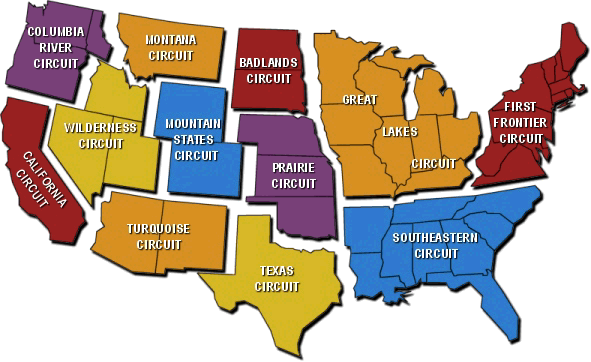
Graphic found online.
Columbia River Circuit – Located in the northwest consisting of Washington, Oregon, the northern tip of Idaho and parts of Montana.
California Circuit – The state of California.
Wilderness Circuit – Located east of California, it includes the majority of Idaho, Nevada and Utah.
Montana Circuit – The state of Montana.
Mountain States Circuit – Includes Wyoming and Colorado.
Turquoise Circuit – Includes the states of New Mexico and Arizona.
Badlands Circuit – Includes North and South Dakota.
Prairie Circuit – Includes Nebraska, Oklahoma and Kansas.
Texas Circuit – The state of Texas.
Great Lakes Circuit – Includes the states of Wisconsin, Iowa, Minnesota, Indiana, Ohio, Illinois, Michigan, Missouri, and Kentucky.
First Frontier Circuit – Is the northeastern most part of the United States and includes Maine, Vermont, New Hampshire, New York, Pennsylvania, Massachusetts, Rhode Island, Connecticut, Virginia, West Virginia, Maryland, Delaware, and New Jersey. With thirteen states, it's the circuit that holds the most states within it's boundaries.
Southeastern Circuit – Includes everything in the southeastern part of the United States which includes Louisiana, Mississippi, Alabama, Georgia, Florida, North Carolina, South Carolina, Tennessee and Arkansas.
Mexican Rodeo Federation (added in 2016) - The Mexican Rodeo Federation has 15 PRCA co-approved rodeos and will be eligible to send two champions in each event to compete at the RNCFR. Source.
Maple Leaf Circuit (added in 2018) - The Canadian Professional Rodeo Association rodeos will allow competitors to earn Maple Leaf Circuit points, with two champions in each event earning spots to compete at the RNCFR. Source.
How does a contestant pick a circuit?
The contestant picks their circuit based off of their preference or off their home address. Meaning that if I am from Louisiana, I could compete in the Southeastern Circuit as my home circuit or I could choose, say, the Wilderness Circuit (or any other circuit for that matter) for my "home" circuit. If a contestant does not determine a separate circuit, the PRCA will allocate them in the circuit that their home address resides in.
Ram National Circuit Finals Rodeo (RNCFR) is now known as the NFR Open held in Colorado

At the end of the season, each of the circuits will have their own respective Circuit Finals rodeo. These finals are held with some in November of the competing year (remember that the ProRodeo Season runs from October through September) and other in February or March of the next year. The contestants for the finals are competing for the top spot at their circuit finals, as well as the overall top spot in the season standings. These top two contestants will represent their Circuit at the NFR Open held in July in Colorado.
These finals have been held in the past in Idaho before moving to Oklahoma in 2011. In 2015, it moved to Kissimmee, Florida, where they have added more sponsor money for the contestants to win - thus the reasoning for the big move to a not so stereotypical rodeo area. The PRCA expected a surge in rodeo’s fan base as they tapped into an exciting tourist location that is loaded with theme parks and other exciting adventures (not unlike the Wrangler National Finals Rodeo in Viva Las Vegas!). They are also a heck of a lot closer for all of the Texas cowboys (who compete in circuits all over the country) than, say, Nevada. It will be harder for the northern contestants to make it, but a chance for nice weather for a winter-ish rodeo is more than exciting for these contestants.
Unfortunately, Kissimmee didn’t provide the draw they expected and announced with new PRCA CEO Tom Glause, the RNCFR was rebranded as the NFR Open to match that of “The Open” in tennis. The reasoning was to create a more mainstream sports branding so that fans would understand the event as a top tier competition. Televised through the Cowboy Channel, the NFR Open was hosted at Pike’s Peak or Bust rodeo in July for the first time in 2022.
Not everyone has the time, nor money, to travel the large tours that the big names (think Trevor Brazile, Tuf Cooper, Bobby Mote, Kaycee Fields, etc.) compete on all around the United States. The circuit system allows a huge opportunity for these people to be rewarded for their time, dedication, and hard work to the sport and it's sponsors. Don't be confused though, the big name contestants will most likely qualify in a circuit for the Ram National Circuit Finals so you will get to see some of the fan favorites competing against the Weekend Warriors.
One of the great attributes of the circuit system is that it allows a younger cowboy or a "weekend warrior" to find success through the ranks, winning larger and larger purses to help fund them down the rodeo trail. It is not a surprise to see someone win enough money through the circuit system to put them on a the national tour and a run for the Wrangler National Finals Rodeo.
As of 2016, monies won at each of the twelve circuit finals and the Ram National Circuit Finals counts towards the PRCA's world standings for that next year. Doesn't make sense? Here's the breakdown:
- Compete in circuit rodeos in 2016
- Qualify to respective circuit finals in 2016 or 2017 (depending on the circuit finals timing)
- Win either your circuit finals or finish the season #1 in the standings for your circuit to qualify for the National Circuit Finals - This money counts toward the 2017 World Standings
- Win money at the 2016 National Circuit Finals (held April 2017 in Florida) - Count the money towards the 2017 World Standings.
This has been an added benefit for competitors to stay closer to home, saving money on gas and travel time. An ever-changing beast, the circuit systems opened up in 2017 to include one new circuit based off the Mexican Rodeo Federation. Stay tuned over the next few years as the PRCA looks to include potentially Canada, Brazil, and more to the RNCFR.
Advancing through the Circuit Finals
All 28 competitors (two from each of the fourteen circuits) compete in two preliminary rounds over the course of two days. In this tournament style finals, the top eight contestants from each event advance to the semifinals. For the semifinals, competitors will see a clean slate start where the previous times and scores will be thrown out. After one semifinal round, the top four for each event advance to the championship round.
The championship round is the "Wrangler Round" where contestants again see a clean slate start with previous times and scores thrown out. Contestants are now competing for the RNCFR title and any of the four who qualify to this championship round are eligible to win.
Stay tuned to the Wrangler Network and the PRCA to find out how your circuit contestants placed at the 2017 Ram National Circuit Finals.
###
This article was originally published on the blog PNW Country Girl and updated and reposted via their permissions.
Updated April 5, 2021 to include circuit additions and updates.