
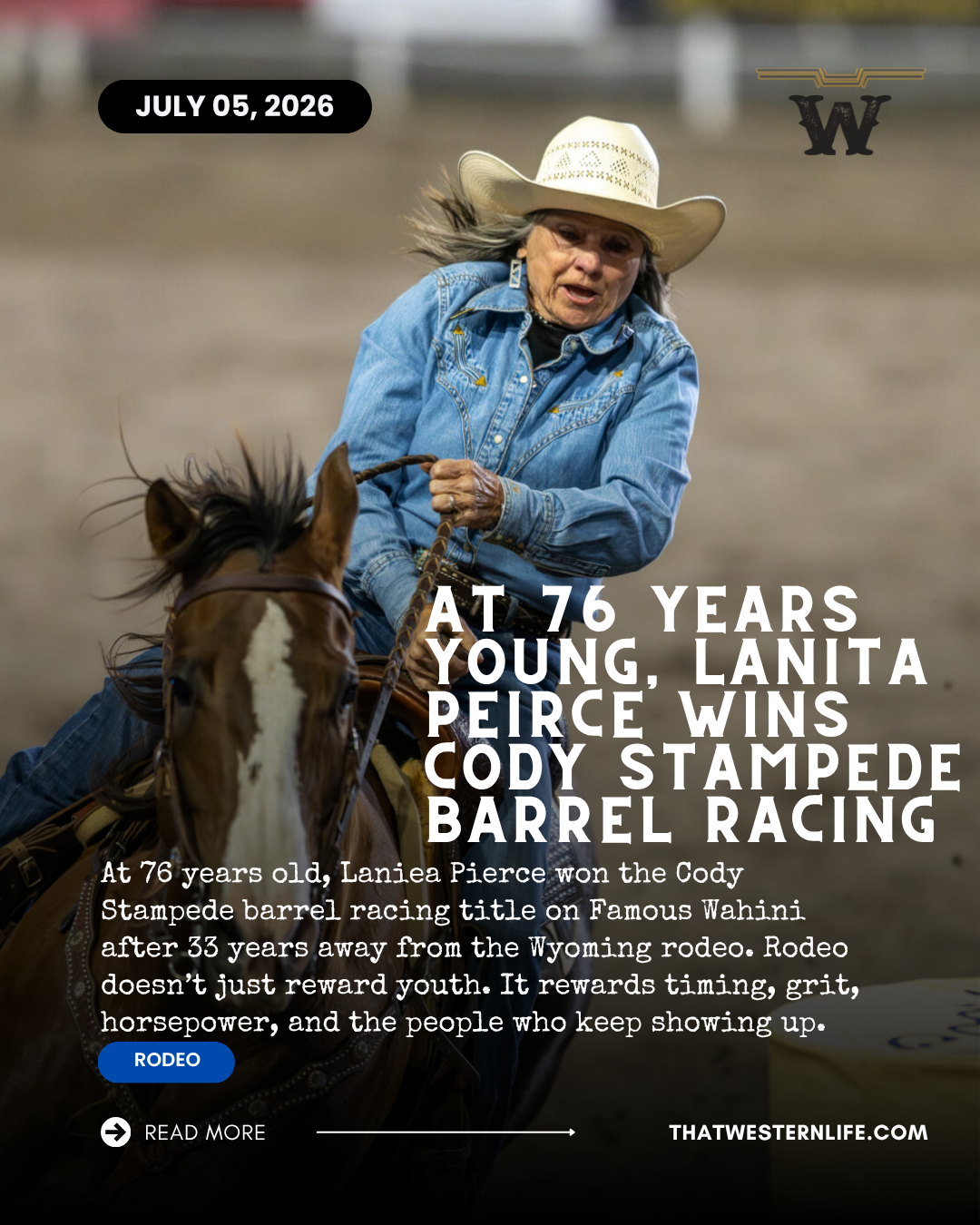
Lanita Peirce Just Gave Rodeo the Kind of Story Sports Fans Remember
At 76 years old, Lanita Peirce won the Cody Stampede barrel racing title on Famous Wahini after 33 years away from the Wyoming rodeo. Rodeo does not just reward youth. It rewards timing, grit, horse power, and the people who keep showing up.
Lanita Peirce winning the 2026 Cody Stampede barrel racing title at 76 years yooung is the kind of rodeo story that should travel far beyond the arena.
Peirce won Cody on Famous Wahini with a 17.06-second run and earned $11,308. Even more remarkable, BarrelRacing.com reported that it had been 33 years since she last made a run at the Wyoming rodeo.
This isn’t just a good run, this is a full-circle western sports moment.
Rodeo often talks about grit, longevity, toughness, and staying power. Peirce’s win puts all of those words into one clean example. At an age when most athletes in most sports are decades removed from serious competition, she entered one of the most recognizable rodeos in the country and won.
Barrel racing is not a ceremonial event. It is fast, technical, physically demanding, and brutally unforgiving. The ride has to make decisions in fractions of a second. The horse has to stay honest, explosive, balanced, and locked in. One tipped barrel, one wide turn, one bad approach, and the run is gone.
This win also reminds people that the horse industry isn’t built only around youth and novelty. Experience matters. Timing matters. Horse sense matters. The relationship between rider and horse matters. A story like this gives rodeo fans something deeper than a result sheet. It gives them a champion to cheer for.
While on paper this might be a competitive rodeo result, it is also a story about horsemanship, patience, and what it means to keep showing up. It also gives marketing value to the sport. Rodeo needs stories that casual fans can understand quickly. “A 76 year-old barrel racer wins Cody Stampede” is immediately compelling. You don’t need to know the standings, bloodlines, or qualifying systems to recognize that this is special.
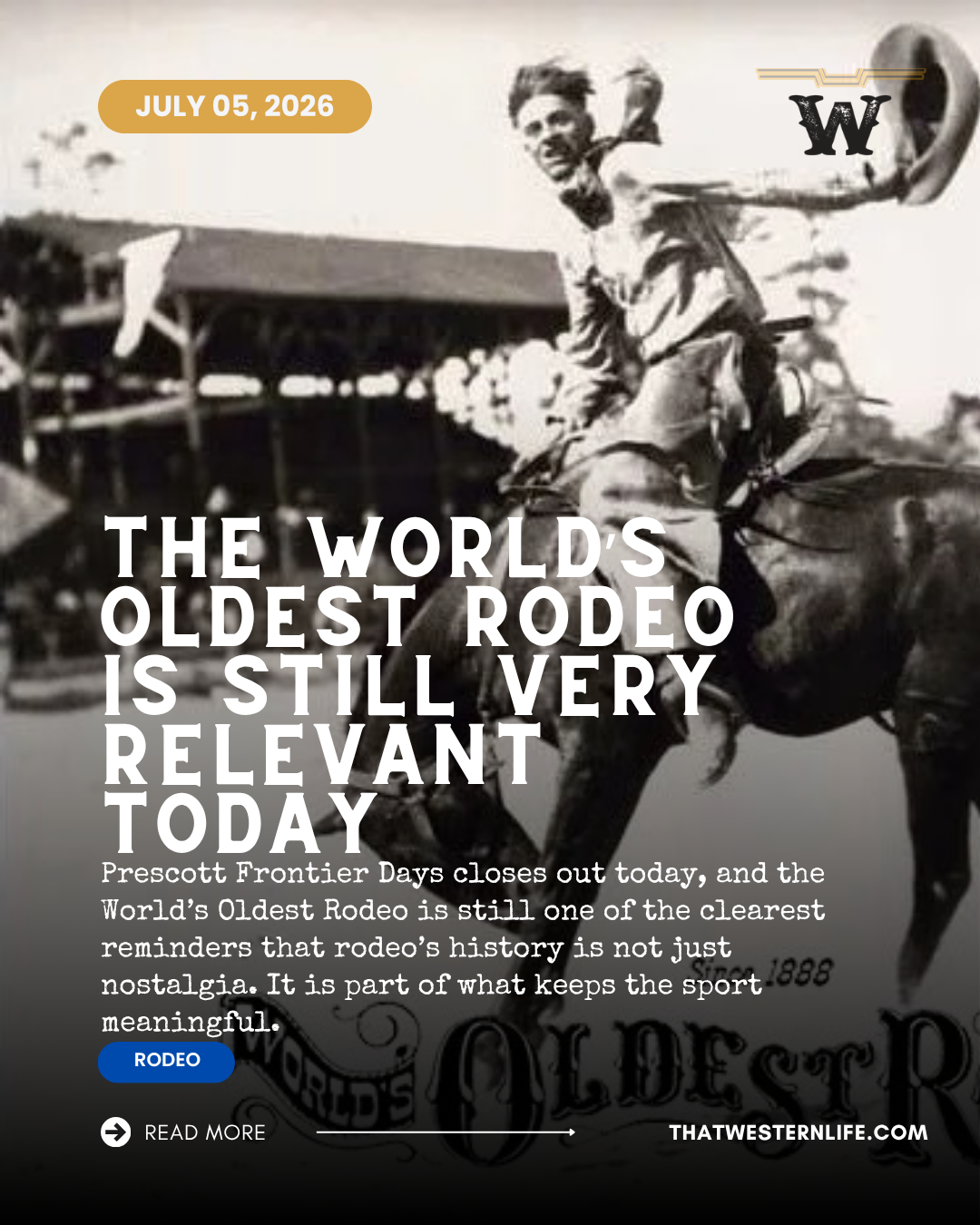
Why Prescott Still Matters in Modern Rodeo
Prescott Frontier Days closes out today, and the World’s Oldest Rodeo is still one of the clearest reminders that rodeo’s history is not just nostalgia. It is part of what keeps the sport meaningful.
Prescott Frontier Days wraps today, and its closing performance deserves attention for more than nostalgia.
Known as the World’s Oldest Rodeo, Prescott sits in a rare position in the western world. It is both a professional rodeo and a heritage institution. Rodeo is a sport that is constantly trying to balance two things at once: honoring where it came from and proving it still belongs in the modern entertainment conversation.
Prescott helps do both.
The 2026 rodeo runs June 29 through July 5, placing it directly inside one of the busiest and most meaningful stretches of the summer season. While many fans are tracking Cowboy Christmas earnings and standings movement, Prescott also gives the industry something deeper to talk about: continuity.
Rodeo did not become a national sport by accident. It grew out of working traditions, local celebrations, stock-handling skills, horsemanship, ranch communities, and people gathering to test themselves in front of their neighbors. Historic rodeos like Prescott keep that origin story visible.
That does not mean the event is stuck in the past. Like every major rodeo, Prescott has to operate in today’s world of ticketing, sponsorships, fan experience, safety, entertainment, media, and tourism. But its value comes from the fact that it can modernize without losing its identity.
That is the real lesson.
The strongest rodeos are not the ones that abandon tradition to chase trends. They are the ones who understand which traditions still mean something and build around them with better production, stronger marketing, and clearer storytelling.
That is where event production and marketing begin to overlap in a meaningful way. It is not just about putting on a clean show or selling tickets. It is about shaping how the audience experiences the story of the rodeo from the moment they see a social post to the moment they leave the grandstands. Every detail, from the opening ceremony to the music cues, announcer tone, sponsor integration, and visual branding, either reinforces the identity of the event or dilutes it.
Katie Schrock of Western Insights Media often frames this as a storytelling problem, not just a marketing one. Rodeos already have powerful stories built into them: heritage, grit, competition, family, and place. The challenge is making sure those stories are communicated clearly and consistently across every touchpoint. When production and marketing teams are aligned, the rodeo becomes more than a series of events. It becomes a narrative that fans can follow, connect with, and return to year after year.
That approach also changes how success is measured. It is not only about attendance numbers or ticket revenue. It is about whether fans understand what makes that rodeo different. It is about whether they remember it, talk about it, and feel connected to it after they leave. Strong storytelling creates loyalty, and loyalty is what sustains historic rodeos like Prescott in a crowded entertainment landscape.
Prescott is a useful reminder that rodeo’s history is not just background information. It is a competitive advantage. Fans want excitement, but they also want a reason to care. Heritage gives them that reason.
As Prescott closes out its 2026 run, the story is not simply that another rodeo week is ending.
The story is that one of rodeo’s oldest stages is still relevant.
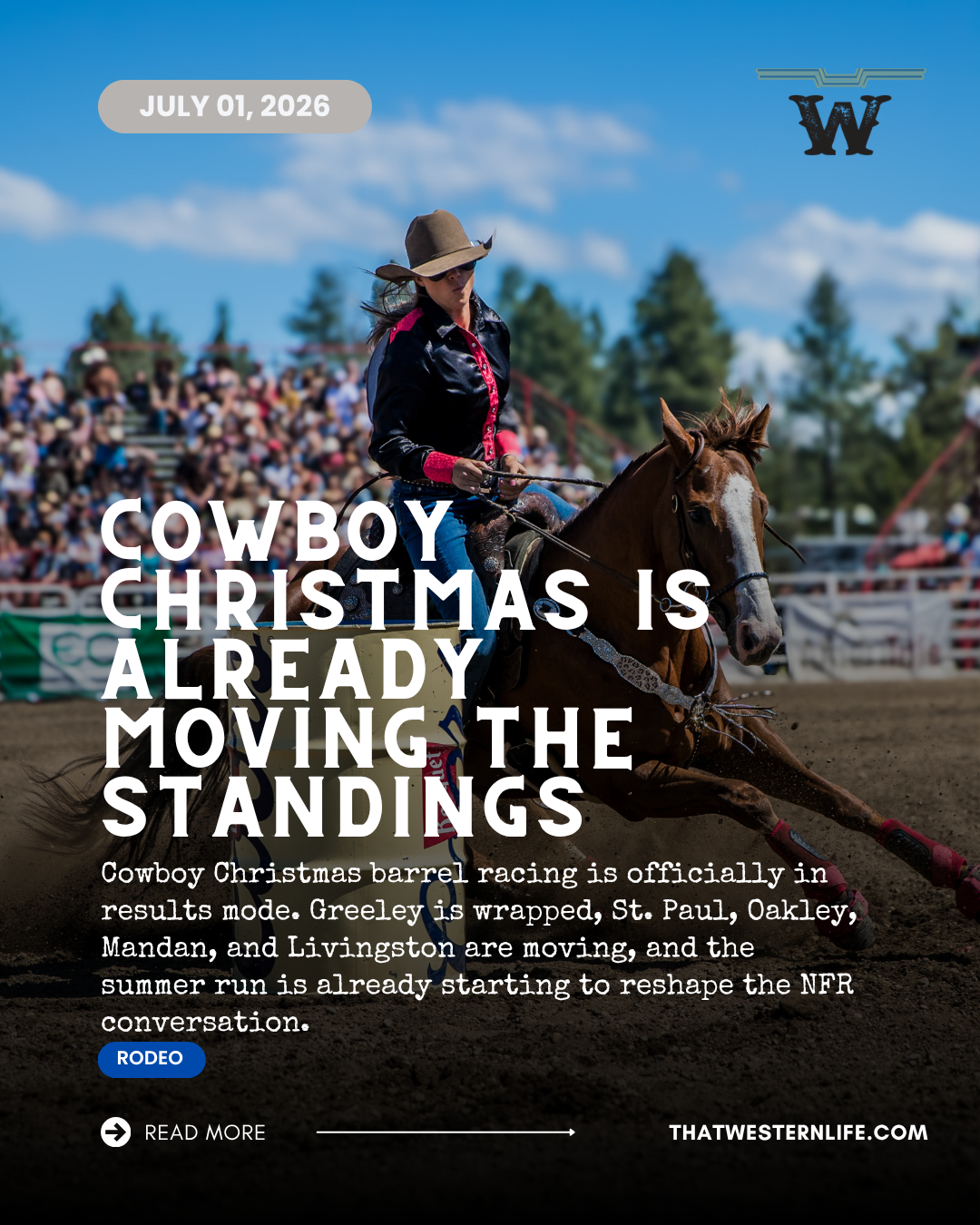
Cowboy Christmas is Already Changing the Barrel Racing Conversation
Cowboy Christmas barrel racing is officially in results mode. Greeley is wrapped, St. Paul, Oakley, Mandan, and Livingston are moving, and the summer run is already starting to reshape the NFR conversation.
Cowboy Christmas is officially moving from preview mode into results mode, and the barrel racing race is already getting sharper.
At Greeley Stampede, Ceily Simpton won the finals with a 17.13-second run, while Raelin Jurgens won the average with 51.93 seconds on three head. Greeley is one of the early tone-setters of the Fourth of July run. A strong finish there can give a cowgirl more than money. It can give her confidence, momentum, and a stronger position heading into one of the most demanding weeks of the season.
But Greeley is only one piece of the map.
Early Cowboy Christmas results also show Hayle Gibson-Stillwell leading at St. Paul, BryAnna Haluptzok leading at Oakley, Hailey Kinsel leading at Mandan, and Kellie Jorgensen leading at Livingston. Those names are spread across several rodeos, but together they tell the real story: the summer run is happening now.
For barrel racers, this week is brutal and valuable at the same time. The schedule is packed, the hauling is intense, and horses have to stay sharp through different ground conditions, arena setups, and travel demands. A fast time is never just a fast time. It is the result of horse management, timing, confidence, and decision-making under pressure.
That is why Cowboy Christmas is one of the most important stretches in professional rodeo. It can push someone closer to the National Finals Rodeo conversation or make the rest of the summer feel much more urgent.
For That Western Life, this is the kind of rodeo story worth covering closely because it helps fans understand how the season is built. The NFR field does not appear out of nowhere in the fall. It is shaped through weeks like this, where every run, every check, and every horse decision matters.
The headline is simple: barrel racing’s summer run is already moving.
And the cowgirls who capitalize now may be the ones we are still talking about in December.
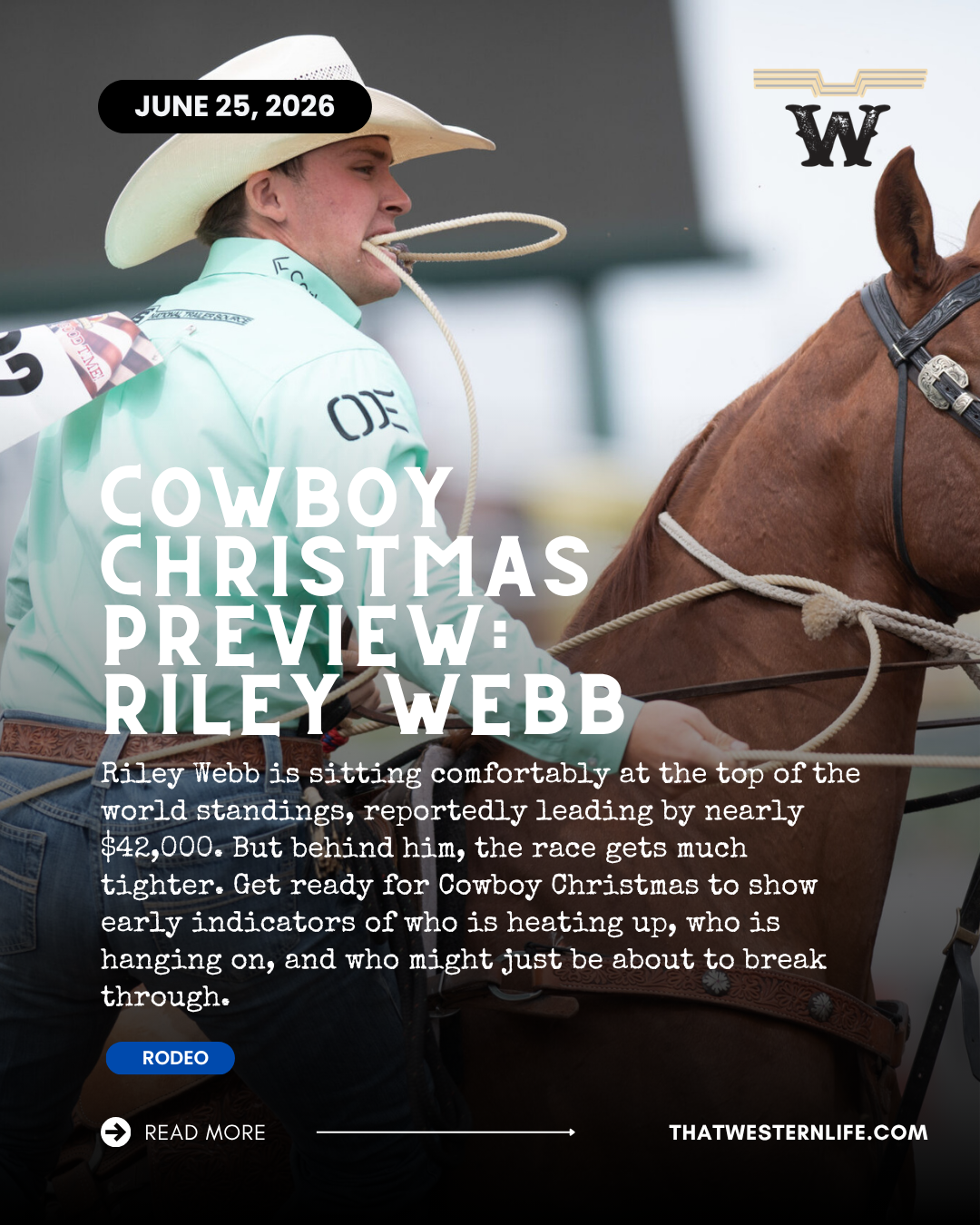
Cowboy Christmas 2026 Preview: Riley Webb
Riley Webb is sitting comfortably at the top of the world standings, reportedly leading by nearly $42,000. But behind him, the race gets much tighter. Get ready for Cowboy Christmas to show early indicators of who is heating up, who is hanging on, and who might just be about to break through.
Cowboy Christmas Is Where The NFR Race Starts Getting Real
Riley Webb is sitting comfortably at the top of the world standings, reportedly leading by nearly $42,000. But behind him, the race gets much tighter. Ty Harris is holding the No. 15 position by less than $700, and several ropers are close enough to change the picture with one strong weekend.
That is what makes Cowboy Christmas one of the most important stretches in professional rodeo.
For casual fans, it can look like a busy run of rodeos around the Fourth of July. For contestants, it is something very different. It is a high-pressure, high-mileage, high-opportunity sprint where every run can shift the standings. A cowboy sitting outside the Top 15 can suddenly become part of the National Finals Rodeo conversation. A veteran can protect his position. A rookie can make a name for himself. A leader can stretch the gap.
This is also when rodeo storytelling gets sharper.
By the time December arrives in Las Vegas, fans know the names that made the NFR. But the stories that get them there often begin right now. Cowboy Christmas is where momentum becomes measurable. It is where consistency gets rewarded. It is where one missed calf, one barrier, one fast time, or one big check can change the season.
For media, sponsors, and rodeo fans, this is the stretch to watch closely. The standings are not just numbers. They are early indicators of who is heating up, who is hanging on, and who may be about to break through.
Tie-down roping is a strong example because the bubble is so tight. When the difference between No. 15 and the next group is measured in hundreds or a few thousand dollars, every rodeo matters. That creates urgency, tension, and a reason for fans to pay attention before the NFR field is set.
The next two weeks will not decide everything. But they will shape a lot.
Cowboy Christmas has always been one of rodeo’s defining runs. This year, the tie-down roping race is giving fans a clean reason to start watching now.
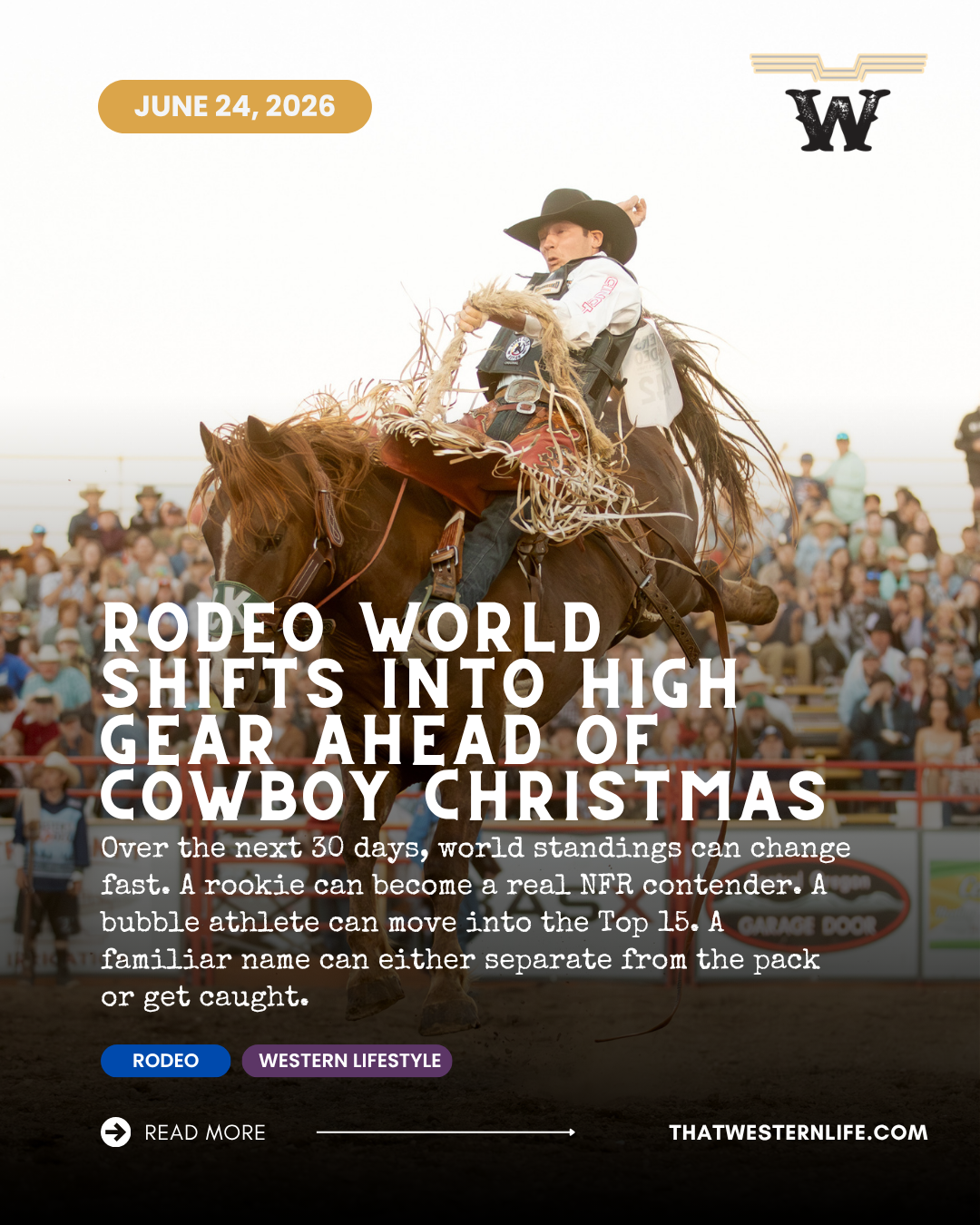
Cowboy Christmas Is Where the NFR Race Starts to Get Expensive
Cowboy Christmas is almost here, and the rodeo world is about to hit one of the most important stretches of the season.
Over the next 30 days, world standings can change fast. A rookie can become a real NFR contender. A bubble athlete can move into the Top 15. A familiar name can either separate from the pack or get caught.
This is the part of the summer where rodeo storylines get made.
As major PRCA rodeos open across the country, all eyes are on who is heating up, who is holding steady, and who is about to make the kind of run that changes their season.
That Western Life will be watching the names moving up, the rodeos that matter, and the stories behind the standings.
Because in rodeo, July does not just pay well.
It decides a lot.
That point usually arrives somewhere between late June and the Fourth of July.
In rodeo, they call it Cowboy Christmas. The name sounds charming, almost quaint, like a dusty holiday built around truck stop coffee, fireworks, and a stack of entry confirmations. In reality, it is one of the most economically consequential stretches of the professional rodeo season.
For roughly ten days, contestants can run at a concentration of high-paying rodeos that rarely exists anywhere else on the calendar. Greeley. Ponoka. St. Paul. Cody. Prescott. Livingston. Red Lodge. Oakley City. Molalla. Belle Fourche. Basin City. Benalto. And a long list of smaller but strategically useful rodeos that can turn one good week into a season-altering swing.
This is not just the busy part of the year.
This is the part where the math starts to get serious.
The NFR Cutline is not a feeling. It is a number.
The National Finals Rodeo takes the Top 15 in each event at the end of the regular season. That phrase, “Top 15,” gets used so often t can lose its weight. But the number required to get there is substantial.
Heading into the 2025 National Finals Rodeo, the No. 15 cutoff in major PRCA/WPRA events generally landed between about $100,000 and $145,000 in regular-season earnings. The low end was breakaway roping, where No. 15 Macy Young entered with $100,028. Steer wrestling’s No. 15, Gavin Soileau, entered with $105,899. Team roping headers and heelers were just above that, at $114,736 and $111,672, respectively. Tie-down roping required $126,957. Bareback riding required $129,951. Bull riding required $138,918. Saddle bronc riding was the highest of this group, with No. 15 Lefty Holman entering at $144,872. Barrel racing’s published 2025 field showed Katelyn Scott in the No. 15 position with $130,763.
Put another way: across those nine NFR event categories, the 2025 average No. 15 threshold was roughly $122,644.
That is the number Cowboy Christmas begins to chase.
A contestant who wins $25,000 to $35,000 over the Fourth of July run has not merely had a good week. They may have banked 20% to 30% of what it took, on average, to make the NFR in 2025.
That is why this stretch matters.
Why the Fourth of July pays differently
The rodeo economy is not evenly distributed.
There are rodeos that matter because of prestige. There are rodeos that matter because of history. There are rodeos that matter because of geography - don’t forget, contestants are still battling for year-end circuit finals as well. And then there are rodeos that matter because the checks are large enough to alter a contestant’s season in one trip.
Cowboy Christmas is where all of those things stack.
St. Paul Rodeo in Oregon says contestants compete for nearly $500,000 in prize money, with top competitors taking home individual winnings as large as $10,000. Cody Stampede, according to the ProRodeo Hall of Fame, draws 800-900 contestants and has a payout of more than $400,000, while also being a one-header rodeo, which means contestants can compete once and keep moving. Greeley Stampede has recently been reported as paying more than $400,000 as well. Ponoka Stampede’s format can produce large individual outcomes, especially through its finals and showdown structure.
That structure is why Cowboy Christmas is not only about talent. It is about logistics.
A contestant has to draw well, compete well, drive all night, manage horses, manage injuries, hit the right set of rodeos, and make the kind of decisions that do not show up in a results sheet. Do you chase the biggest check? Do you take the rodeo that fits your horse? Do you skip a rodeo to keep one fresh? Do you enter a smaller stop because it is on the route and the odds are better?
The standings reward money. But Cowboy Christmas tests judgment.
The case studies
Halyn Lide
In 2024, barrel racer Halyn Lide became a clean example of what this stretch can do.
Lide was the highest-earning barrel racer over Cowboy Christmas, with reported earnings of roughly $32,550 across the Fourth of July run. Her money came from major stops including Ponoka, Greeley, and Oakley, Utah. She won Greeley and Oakley, and also picked up a go-round win at Ponoka.
The result was not just a good week. It changed the way people talked about her season.
By late November, The Cowboy Channel framed Lide as a first-time NFR qualifier and pointed back to her Cowboy Christmas earnings as a major piece of that climb. That is the function of this run: it turns “watch her” into “she is in the race.”
For fans, that is the moment to pay attention. Not in December, when the back numbers are already assigned. In July, when a contestant starts putting pressure on the bubble.
Emily Beisel
Emily Beisel offers the veteran version of the same story.
In 2024, Beisel finished just behind Lide among Cowboy Christmas barrel racing earners, with $30,211. The breakdown is the important part: $17,460 at Ponoka, $11,086 at St. Paul, and $1,665 at Red Lodge.
That kind of week does two things. First, it moves money into the standings quickly. Second, it confirms a competitor’s summer strategy.
Beisel was not an unknown name. She was already one of the sport’s proven winners. But Cowboy Christmas can serve veterans differently than rookies. For a new name, it creates attention. For a veteran, it creates separation.
In a season where the No. 15 barrel racing cutoff was around $130,000 the following year, a $30,000 Fourth of July run represents nearly a quarter of that benchmark.
That is not momentum as a metaphor. That is momentum as arithmetic.
Riley Webb
Tie-down roper Riley Webb delivered the 2025 version.
Webb reportedly won $32,537 during Cowboy Christmas 2025, with checks at Cody, St. Paul, Killdeer, Basin City, Livingston, and Greeley. The largest piece came from St. Paul, where he won $16,235. He also added $5,090 at Basin City, $4,599 at Greeley, and $4,376 at Cody.
Compare that to the 2025 NFR tie-down roping cutoff: Shane Hanchey entered the NFR at No. 15 with $126,957. Webb’s Fourth of July run alone was equal to roughly 25.6% of that threshold.
That is the scale of the opportunity.
A single week cannot make an NFR season by itself. But a week like that can change the pressure of every rodeo that follows. It can move a contestant from chasing the bubble to defending a position. It can make a sponsor notice. It can make media start writing the name differently. It can make every check in August and September feel like a step toward Las Vegas rather than a rescue mission.
What fans should watch
Cowboy Christmas is not only about who wins the famous rodeos. Sometimes the more interesting story is who places everywhere.
A roughstock rider who wins one major rodeo can make a leap. A timed-event contestant who places at five stops may do even more damage. A barrel racer who gets through Ponoka, Greeley, St. Paul, and a smaller rodeo with clean runs can suddenly become impossible to ignore.
The names to watch are not only the world No. 1s. They are the contestants sitting from roughly No. 12 to No. 25 in the standings before the run begins.
That is the volatile zone.
A contestant already inside the Top 10 can use Cowboy Christmas to build distance. A contestant sitting just outside the Top 15 can use it to break in. A rookie can use it to become a storyline. A veteran can use it to remind everyone that summer rodeo is not won by hype, but by cashing checks in places most fans only see as dots on a map.
Why this matters for rodeo media
For That Western Life, Cowboy Christmas is exactly the kind of stretch that deserves more attention.
Rodeo coverage often gets loudest when champions are crowned. But the more interesting story often starts earlier, when the standings are still unsettled and the sport has not yet agreed on who matters.
This is where the NFR race begins to sharpen.
This is where unknown names become dangerous.
This is where good horses become famous.
This is where a contestant can go from “having a decent year” to “we need to talk about them.”
And this is where fans can learn to watch rodeo differently.
The Fourth of July run is not just a holiday tradition. It is a market correction. It rewards the contestants who can win, travel, manage risk, and keep performing when the sport asks the most from them in the shortest window.
By the time December arrives, the NFR field can feel inevitable.
In July, it is still being built.

Ivy & Hawkins Have Their Cowboy Christmas Arena Record Style
Lane Ivy, a team roping header out of Adrian, Texas, and Buddy Hawkins II, a team roping heeler from Sedan, Kansas, decided to have their Cowboy Christmas arena record style this year, setting arena records at two Pacific Northwest Rodeos!
Lane Ivy, a team roping header out of Adrian, Texas, and Buddy Hawkins II, a team roping heeler from Sedan, Kansas, decided to have their Cowboy Christmas arena record style this year!
"Cowboy Christmas" is a term used by rodeo fans to describe the lucrative number of professional and amateur rodeos held over the 4th of July weekend. Cowboys can move up significant placings in the Weatherguard World Standings of the Professional Rodeo Cowboys Association, allowing them to strategically set themselves up for the sprint to be in the Top 15 to go to the Wrangler National Finals Rodeo in December. The Super Bowl of rodeo, the WNFR is the place to be for any western enthusiast.
On July 3rd, at the Eugene Pro Rodeo in Eugene, Oregon, Ivy and Hawkins smoked a 4.6 second run in Eugene, a place where a 5 flat is considered fast. The time was good enough for first overall with a new arena record.
The following day, Hawkins and Ivy got to celebrate America's birthday with another arena record at the Molalla Buckaroo in Molalla, Oregon. Stopping the clock in a deadly 3.9 second run, they took the lead at another Cowboy Christmas rodeo.
Watch Ivy/Hawkins Eugene Pro Arena Record here.
Watch Ivy/Hawkins Molalla Buckaroo Arena Record here.
Ivy currently sits 36th in the world according to the PRCA Weatherguard World Standings but is sure to move after the books have officially closed on the Cowboy Christmas run. Hawkins currently sits 10th in the PRCA Weatherguard World Standings and is sitting pretty as we head into the final stretch of the year heading into the WNFR.
Team roping is the only true team event for Professional Rodeo where a header and a heeler work together to stop the clock. The header throws their loop first catching the horns, neck or a combination of both on a 350-500 pound Corriente steer. The header must then turn the steer to the left and, once that direction change has been made, the heeler tries to catch both hind legs. The clock stops when both horses are facing each other with their front feet on the ground, as signaled by a judge. Time penalties can be accrued with the breaking of the barrier (the head start for the steer) or by the heeler only catching one leg (+5 seconds).
Follow Buddy Hawkins II Fan Page on Facebook.
That Western Life was founded in 2017 and promotes the western industry including rodeo sports, agriculture and ranching politics, western lifestyle, and the people that make this great nation what it is. Our thoughts and opinions are our own.