
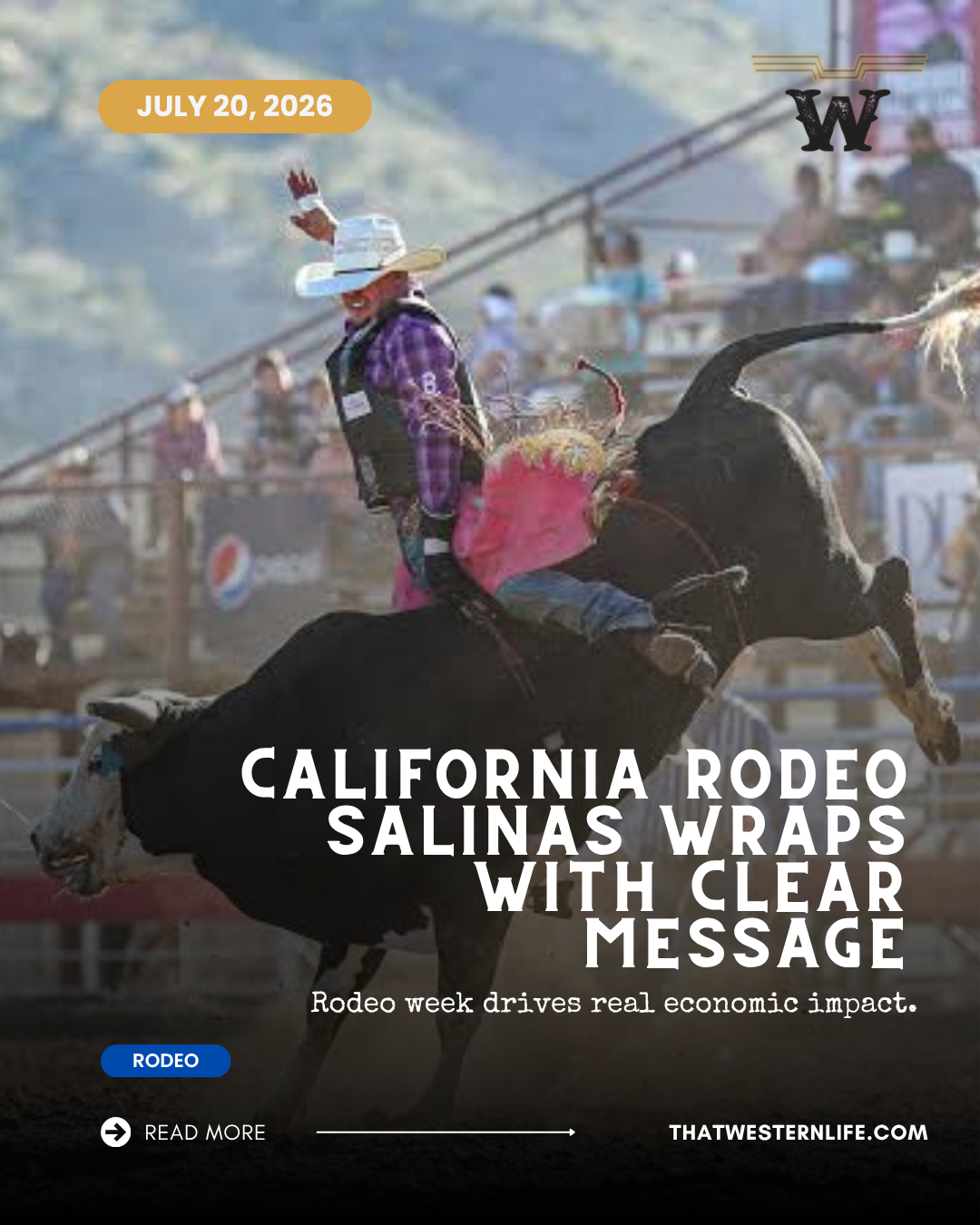
California Rodeo Salinas Wraps With a Clear Message: Rodeo Week Drives Real Economic Impact
The 116th California Rodeo Salinas wrapped with a clear reminder that major rodeo events are no longer just four days of competition — they are full-scale economic engines. Through Big Week Bull Riding, themed performances, concerts, carnival programming, community events, and agricultural recognition, Salinas created a weeklong event model that drove tourism, hotel stays, restaurant traffic, vendor sales, seasonal employment, and regional visibility. The rodeo’s continued connection to Salinas Valley agriculture also reinforces why western events matter beyond entertainment: they support local economies, preserve cultural identity, and showcase the industries that sustain their communities.
The 116th California Rodeo Salinas has officially conclused, wrapping up four performances at the Salinas Sports Complex and closing out what has become one of the most economically influential western events in the country. While the competition delivered as expected, the larger takeaway is how effectively Salinas has transformed rodeo into a full-week economic enginge for the region.
The week began with Big Week Bull Riding, part of the PRCA’s Xtreme Bulls Tour, and carried through themed rodeo performances including Bucking Cancer Night and Ag Appreciation Night. By the weekend, afternoon perforamnces allowed for broader attendance, giving families and visitors multiple entry points into the event.
But the rodeo itself was only one piece of a much larger system.
Concerts, including a Big Week Kick Off headlined by Miranda Lambert alongside Dylan Scott and Ashley Cooke, drew crowds early in the week. The carnival, community events and surrounding attractions extended engagement well beyond the arena gates in what can only be measured in a socioeconomic study.
Hotels filled across Salinas and surrounding communities. Restaurants, bars and retail businesses saw increased traffic throughout the week. Temporary and seasonal employment opportunities expanded, from event staffing to hospitality services. Local vendors and small businesses benefited from sustained foot traffic rather than a single-night surge.
This is where the modern rodeo model becomes significant.
Events like Salinas are no longer just sporting competitions. They function as regional economic drivers that support tourism, agriculture, small business growth and community identity. A visitor may attend one rodeo performance, but their spending often stretches across lodging, dining, entertainment and retail over multiple days.
That extended engagement creates a ripple effect.
Revenue generated during rodeo week circulates through the local economy, supporting jobs, infrastructure and future investment. Sponsorship dollars increase as brands recognize the broader audience reach. Media exposure expands beyond rodeo coverage into lifestyle, tourism and regional promotion.
At the same time, Salinas maintained a strong connection to its agricultural roots.
Ag Appreciation Night reinforced the role of farming and ranching in the Salinas Valley, where agriculture is not symbolic—it is foundational to the local economy. By highlighting that connection, the rodeo strengthens public awareness of the industries that sustain the region while reinforcing cultural identity.
The result is a layered socioeconomic impact.
Rodeo provides the anchor, but the surrounding programming builds accessibility, inclusivity and economic opportunity. Families, tourists, industry professionals and first-time attendees all find different reasons to participate, broadening the event’s reach across income levels and demographics.
The 2025 California Rodeo Salinas did more than deliver four days of competition.
It demonstrated how a well-structured rodeo week can generate sustained economic activity, support local communities and reinforce the cultural and financial relevance of the western industry in a modern economy.
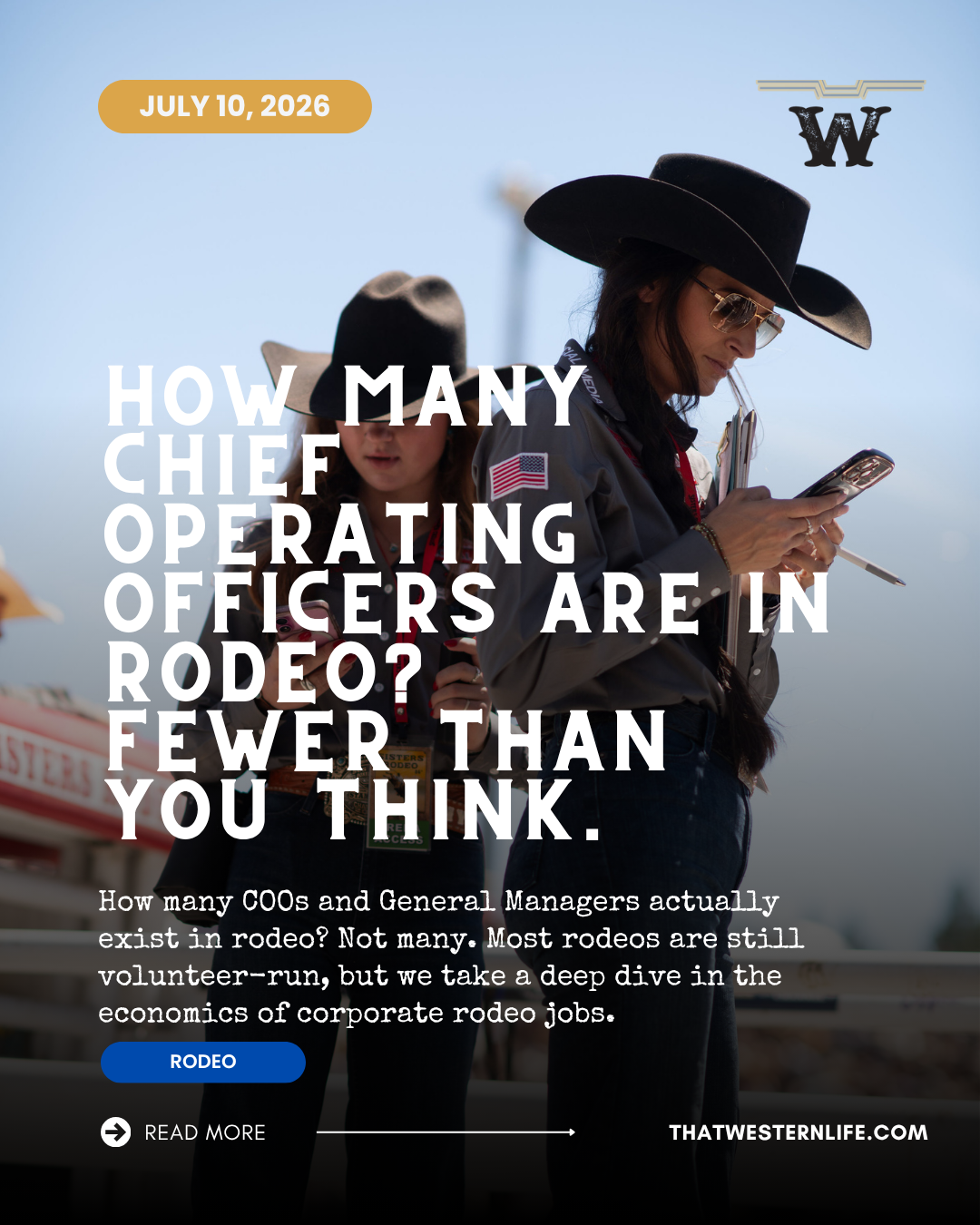
What Rodeo Job Titles Actually Mean ... And How Many Exist Across the Industry
How many COOs and General Managers actually exist in rodeo? Not many. Most rodeos are still volunteer-run, but the biggest events are starting to look more like full-scale businesses. Here’s a breakdown of what these titles mean and how common they really are across the country.
The Houston LIvestock Show & Rodeo creating a Chief Operating Officer/ General Manager role is a big signal, but it also raises a bigger question: What do these titles actually mean in rodeo, and how common are they across the country?
How Rodeo Leadership Is Structured
Unlike traditional corporations, professional rodeo is not one unified company. It is a mix of:
Nonprofit rodeo committees
Fair & livestock show organizations
City or county-run events
Private stock contractor businesses
Sanctioning bodies like the PRCA
Because of that, job titles vary widely depending on the size and structure of the rodeo leadership roles tyupically break down.
Executive director/ceo
This is the most common top leadership role in rodeo.
Oversees the entire organization
Reports to a board of directors
Responsible for long-term strategy, finances, and mission
Common in nonprofit rodeos and livestock shows
Examples: Houston Rodeo (CEO), San Antonio Rodeo (CEO), Fort Worth Stock Show (President/GM Hybrid)
Estimated across the U.S.: Roughly 150-250 rodeos and livestock shows have a full-time Executive Director or CEO-type role.
General Manager (GM)
This role focuses more on operations and execution.
Runs day-to-day event logistics
Oversees staff, vendors, and production
Often reports to the CEO or board
Common in mid-size to large rodeos
In some organizations, the GM is the top leader. In others, they are second-in-command.
Estimated across the U.S.: Approximately 75-100 rodeos have a formal General Manager role.
chief operating officer (CO)
This is still relatively rare in rodeo.
Oversees operations across multiple departments
Aligns logistics, production, and execution
Usually exists only in very large, complex organizations
Often paired with a CEO or President
Houston creating a COO role is notable because it reflects a more corporate-style structure.
Estimated across the U.S.: Likely fewer than 10-20 rodeos have a true COO position.
Combined coo / general manager roles
Some large rodeos combine these responsibilities into one position, like Houston just did.
Oversees both the strategy execution and daily operations
Acts as the bridge between leadership vision and event delivery
Requires experience in sponsorship, ticketing, operations, and production
Estimated across the U.S.: Probably fewer than 10 organizations operate with this combined structure.
Why Most Rodeos Do Not Have These Roles
Tha majority of rodeos in the U.S. are smaller, volunteer-driven events.
Many rely on committees instead of full-time executives
Leadership is often part-time or seasonal
Budgets do not support multiple C-level positions
Out of the 600+ PRCA-sanctioned rodeos and hundreds more independent events:
Only a small percentage operate like full-scale businesses
Even fewer have corporate-style leadership structures
What’s Houston’s Recent Move Really Signals
Houston is not the norm - it’s top tier.
Events like Houston, San Antonio, Fort Worth, Denver, and Calgary operate more like major entertainment companies than traditional rodeos. They manage:
Multi-week events
Millions of attendees
Large sponsorship portfolios
Concert series
Year-round programming
At that scale, having a COO or GM is not optional - it is necessary.
The Big Picture
Across the entire professional rodeo lanscape in the United States:
Executive Director / CEO Roles: ~ 150-250
General Manager roles: ~ 75-150
COO roles: ~10-20
Combined COO/GM roles: fewer than 10
That means true corporate-style leadership exists in only a small fraction of rodeo organizations.
The Significance of These Numbers
Rodeo is evolving.
The biggest events are becoming complex business operations that require leadership with experience in:
Spnosorship and partnerships
Ticketing and revenue strategy
Event production
Guest experience
Operations management
Houston’s new role is not just about one hire, though. It signifies that the top end of rodeo is moving toward a more structured, professional business model, while the majority of rodeos still operate on tradition, volunteers, and community leadership.
Both models matter.
But understanding the difference is key to understanding where the industry is headed.
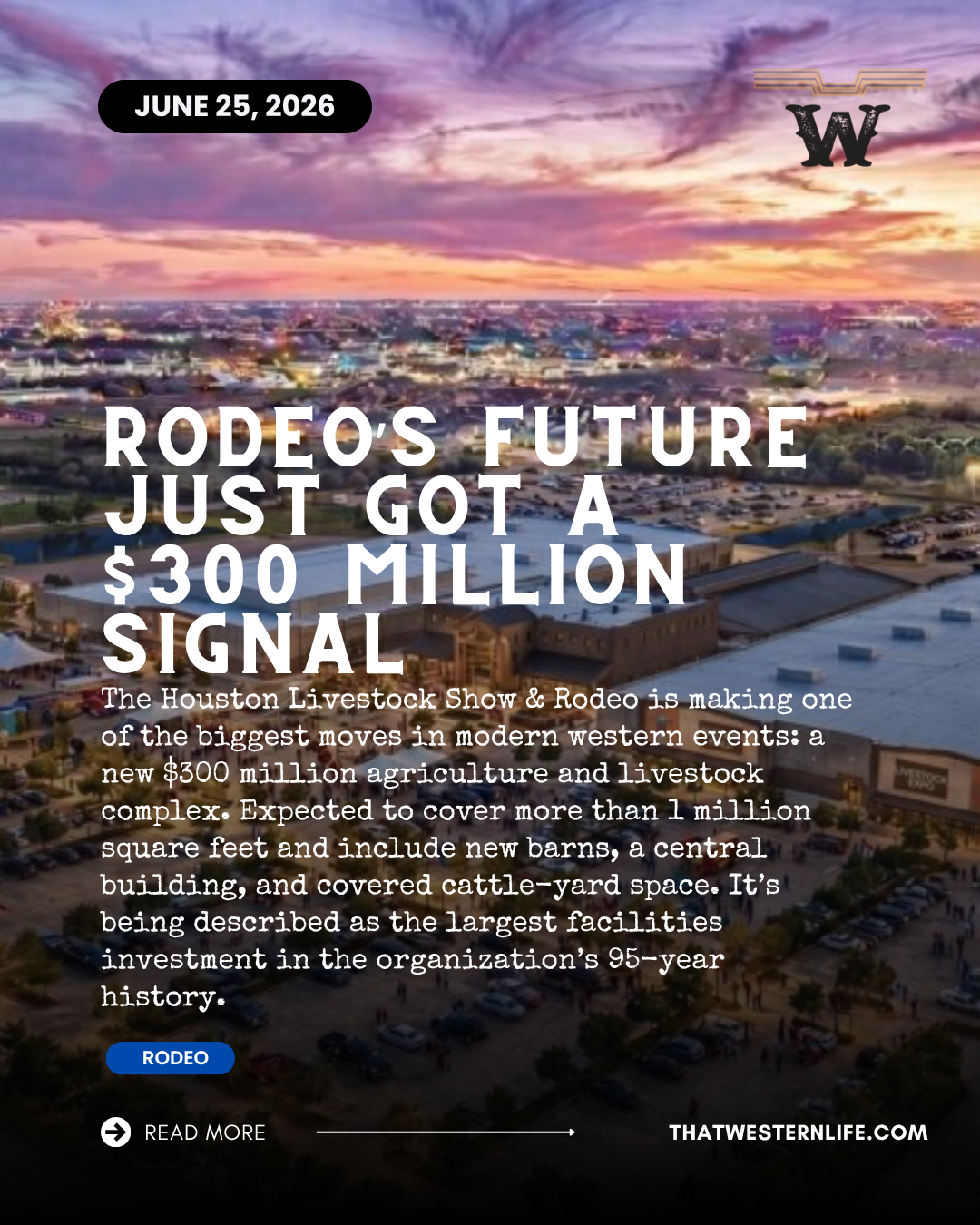
Houston Rodeo's $300 Million Ag Complex is Bigger Than a Building Project
Houston Rodeo just announced a $300 million agricultural complex, and this is more than a facilities upgrade. It is a major reminder that rodeo’s future is tied to livestock, youth programs, ag education, and year-round western impact. The arena matters. But the roots matter just as much.
The Houston Livestock Show and Rodeo is making one of the biggest moves in modern western events: a new $300 million agricultural and livestock complex.
The project is expected to cover more than 1 million square feet and include new barns, a central building, and covered cattle-yard space. It is being described as the largest facilities investment in the organization’s 95-year history, with a target opening ahead of the 2029 rodeo season.
But this story is bigger than square footage.
For the western world, Houston’s investment is a clear signal that rodeo’s future is not only in the arena. It is in livestock education, youth programs, horse shows, auctions, ag events, and year-round community use. The biggest rodeo organizations in the country are no longer treating agriculture as a side piece of the event. They are building infrastructure around it.
That matters because the livestock and agriculture side of rodeo is often what gives the sport its deepest roots. The concerts may bring in casual fans. The rodeo performances may sell the tickets. But livestock shows, FFA and 4-H participation, scholarships, breeding programs, youth exhibitors, and agricultural education are what connect rodeo to the next generation.
This new complex also points to a bigger trend across western events: rodeos are becoming full-scale western lifestyle platforms. The strongest events are not just producing one week of entertainment. They are creating economic engines, educational hubs, tourism drivers, and community gathering places.
For Houston, this investment strengthens its position as one of the most influential western events in the country. For the rest of the industry, it raises the bar.
Not every rodeo can build a $300 million complex. Most cannot. But every rodeo can look at this move and ask the same strategic question: are we only selling tickets, or are we building something that serves agriculture, youth, sponsors, and western culture year-round?
That is the real takeaway.
Houston is not just expanding facilities. It is reinforcing the idea that rodeo’s future depends on keeping agriculture visible, valuable, and central to the story.
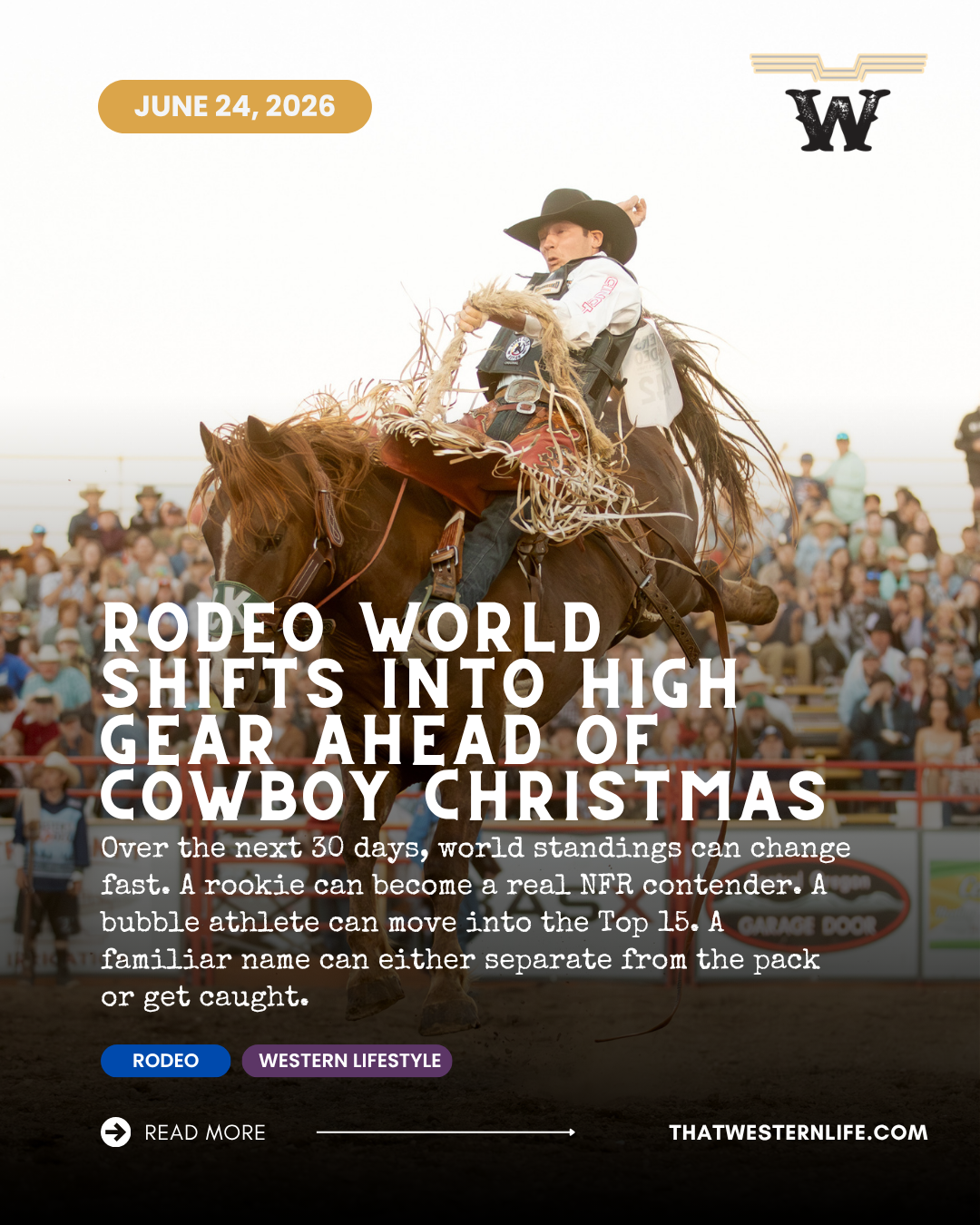
Cowboy Christmas Is Where the NFR Race Starts to Get Expensive
Cowboy Christmas is almost here, and the rodeo world is about to hit one of the most important stretches of the season.
Over the next 30 days, world standings can change fast. A rookie can become a real NFR contender. A bubble athlete can move into the Top 15. A familiar name can either separate from the pack or get caught.
This is the part of the summer where rodeo storylines get made.
As major PRCA rodeos open across the country, all eyes are on who is heating up, who is holding steady, and who is about to make the kind of run that changes their season.
That Western Life will be watching the names moving up, the rodeos that matter, and the stories behind the standings.
Because in rodeo, July does not just pay well.
It decides a lot.
That point usually arrives somewhere between late June and the Fourth of July.
In rodeo, they call it Cowboy Christmas. The name sounds charming, almost quaint, like a dusty holiday built around truck stop coffee, fireworks, and a stack of entry confirmations. In reality, it is one of the most economically consequential stretches of the professional rodeo season.
For roughly ten days, contestants can run at a concentration of high-paying rodeos that rarely exists anywhere else on the calendar. Greeley. Ponoka. St. Paul. Cody. Prescott. Livingston. Red Lodge. Oakley City. Molalla. Belle Fourche. Basin City. Benalto. And a long list of smaller but strategically useful rodeos that can turn one good week into a season-altering swing.
This is not just the busy part of the year.
This is the part where the math starts to get serious.
The NFR Cutline is not a feeling. It is a number.
The National Finals Rodeo takes the Top 15 in each event at the end of the regular season. That phrase, “Top 15,” gets used so often t can lose its weight. But the number required to get there is substantial.
Heading into the 2025 National Finals Rodeo, the No. 15 cutoff in major PRCA/WPRA events generally landed between about $100,000 and $145,000 in regular-season earnings. The low end was breakaway roping, where No. 15 Macy Young entered with $100,028. Steer wrestling’s No. 15, Gavin Soileau, entered with $105,899. Team roping headers and heelers were just above that, at $114,736 and $111,672, respectively. Tie-down roping required $126,957. Bareback riding required $129,951. Bull riding required $138,918. Saddle bronc riding was the highest of this group, with No. 15 Lefty Holman entering at $144,872. Barrel racing’s published 2025 field showed Katelyn Scott in the No. 15 position with $130,763.
Put another way: across those nine NFR event categories, the 2025 average No. 15 threshold was roughly $122,644.
That is the number Cowboy Christmas begins to chase.
A contestant who wins $25,000 to $35,000 over the Fourth of July run has not merely had a good week. They may have banked 20% to 30% of what it took, on average, to make the NFR in 2025.
That is why this stretch matters.
Why the Fourth of July pays differently
The rodeo economy is not evenly distributed.
There are rodeos that matter because of prestige. There are rodeos that matter because of history. There are rodeos that matter because of geography - don’t forget, contestants are still battling for year-end circuit finals as well. And then there are rodeos that matter because the checks are large enough to alter a contestant’s season in one trip.
Cowboy Christmas is where all of those things stack.
St. Paul Rodeo in Oregon says contestants compete for nearly $500,000 in prize money, with top competitors taking home individual winnings as large as $10,000. Cody Stampede, according to the ProRodeo Hall of Fame, draws 800-900 contestants and has a payout of more than $400,000, while also being a one-header rodeo, which means contestants can compete once and keep moving. Greeley Stampede has recently been reported as paying more than $400,000 as well. Ponoka Stampede’s format can produce large individual outcomes, especially through its finals and showdown structure.
That structure is why Cowboy Christmas is not only about talent. It is about logistics.
A contestant has to draw well, compete well, drive all night, manage horses, manage injuries, hit the right set of rodeos, and make the kind of decisions that do not show up in a results sheet. Do you chase the biggest check? Do you take the rodeo that fits your horse? Do you skip a rodeo to keep one fresh? Do you enter a smaller stop because it is on the route and the odds are better?
The standings reward money. But Cowboy Christmas tests judgment.
The case studies
Halyn Lide
In 2024, barrel racer Halyn Lide became a clean example of what this stretch can do.
Lide was the highest-earning barrel racer over Cowboy Christmas, with reported earnings of roughly $32,550 across the Fourth of July run. Her money came from major stops including Ponoka, Greeley, and Oakley, Utah. She won Greeley and Oakley, and also picked up a go-round win at Ponoka.
The result was not just a good week. It changed the way people talked about her season.
By late November, The Cowboy Channel framed Lide as a first-time NFR qualifier and pointed back to her Cowboy Christmas earnings as a major piece of that climb. That is the function of this run: it turns “watch her” into “she is in the race.”
For fans, that is the moment to pay attention. Not in December, when the back numbers are already assigned. In July, when a contestant starts putting pressure on the bubble.
Emily Beisel
Emily Beisel offers the veteran version of the same story.
In 2024, Beisel finished just behind Lide among Cowboy Christmas barrel racing earners, with $30,211. The breakdown is the important part: $17,460 at Ponoka, $11,086 at St. Paul, and $1,665 at Red Lodge.
That kind of week does two things. First, it moves money into the standings quickly. Second, it confirms a competitor’s summer strategy.
Beisel was not an unknown name. She was already one of the sport’s proven winners. But Cowboy Christmas can serve veterans differently than rookies. For a new name, it creates attention. For a veteran, it creates separation.
In a season where the No. 15 barrel racing cutoff was around $130,000 the following year, a $30,000 Fourth of July run represents nearly a quarter of that benchmark.
That is not momentum as a metaphor. That is momentum as arithmetic.
Riley Webb
Tie-down roper Riley Webb delivered the 2025 version.
Webb reportedly won $32,537 during Cowboy Christmas 2025, with checks at Cody, St. Paul, Killdeer, Basin City, Livingston, and Greeley. The largest piece came from St. Paul, where he won $16,235. He also added $5,090 at Basin City, $4,599 at Greeley, and $4,376 at Cody.
Compare that to the 2025 NFR tie-down roping cutoff: Shane Hanchey entered the NFR at No. 15 with $126,957. Webb’s Fourth of July run alone was equal to roughly 25.6% of that threshold.
That is the scale of the opportunity.
A single week cannot make an NFR season by itself. But a week like that can change the pressure of every rodeo that follows. It can move a contestant from chasing the bubble to defending a position. It can make a sponsor notice. It can make media start writing the name differently. It can make every check in August and September feel like a step toward Las Vegas rather than a rescue mission.
What fans should watch
Cowboy Christmas is not only about who wins the famous rodeos. Sometimes the more interesting story is who places everywhere.
A roughstock rider who wins one major rodeo can make a leap. A timed-event contestant who places at five stops may do even more damage. A barrel racer who gets through Ponoka, Greeley, St. Paul, and a smaller rodeo with clean runs can suddenly become impossible to ignore.
The names to watch are not only the world No. 1s. They are the contestants sitting from roughly No. 12 to No. 25 in the standings before the run begins.
That is the volatile zone.
A contestant already inside the Top 10 can use Cowboy Christmas to build distance. A contestant sitting just outside the Top 15 can use it to break in. A rookie can use it to become a storyline. A veteran can use it to remind everyone that summer rodeo is not won by hype, but by cashing checks in places most fans only see as dots on a map.
Why this matters for rodeo media
For That Western Life, Cowboy Christmas is exactly the kind of stretch that deserves more attention.
Rodeo coverage often gets loudest when champions are crowned. But the more interesting story often starts earlier, when the standings are still unsettled and the sport has not yet agreed on who matters.
This is where the NFR race begins to sharpen.
This is where unknown names become dangerous.
This is where good horses become famous.
This is where a contestant can go from “having a decent year” to “we need to talk about them.”
And this is where fans can learn to watch rodeo differently.
The Fourth of July run is not just a holiday tradition. It is a market correction. It rewards the contestants who can win, travel, manage risk, and keep performing when the sport asks the most from them in the shortest window.
By the time December arrives, the NFR field can feel inevitable.
In July, it is still being built.