
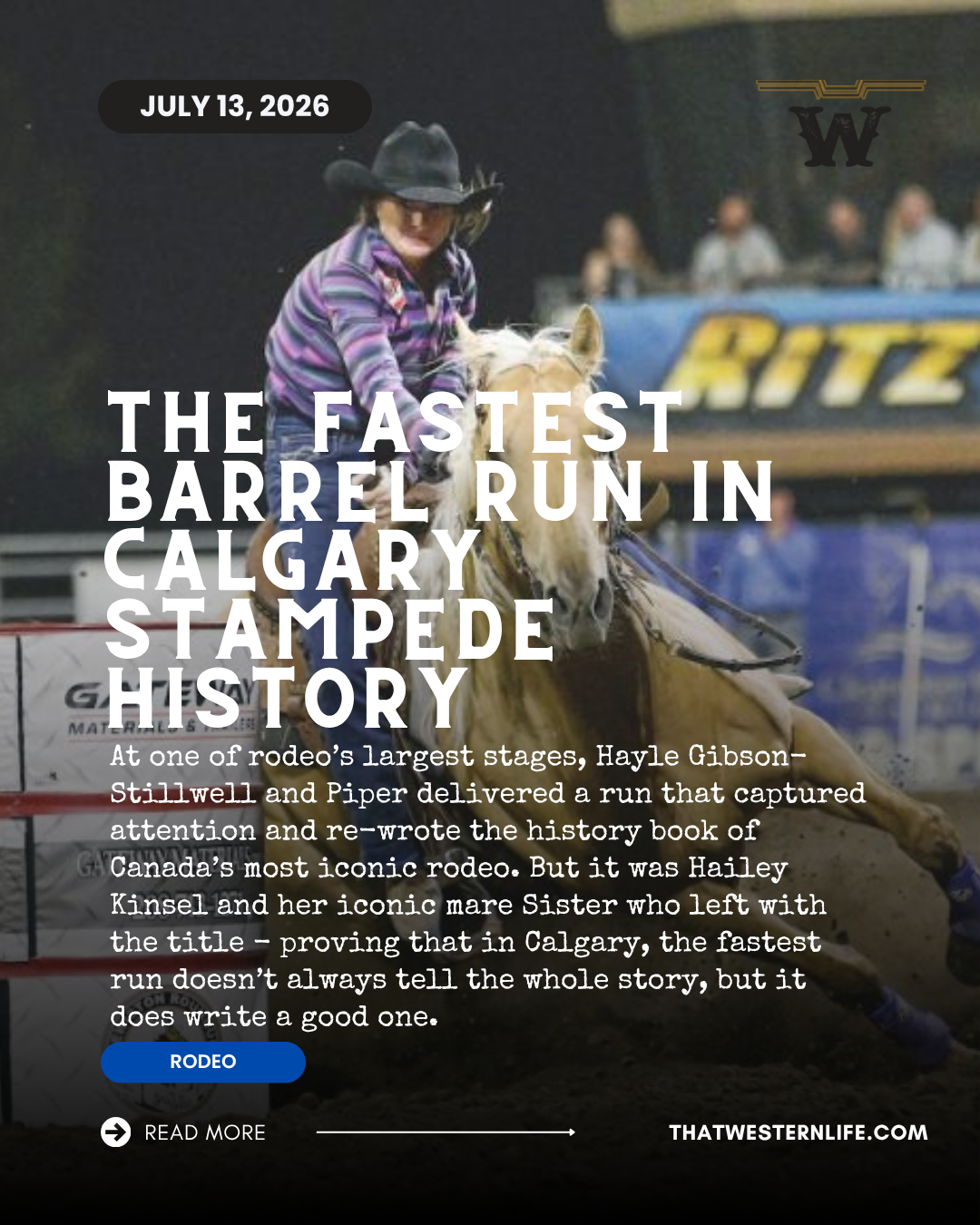
Hayle Gibson-Stillwell and Piper Rewrite the Calgary Stampede Record Book
At one of rodeo’s largest stages, Hayle Gibson-Stillwell and Piper delivered a run that captured attention and re-wrote the history book of Canada’s most iconic rodeo. But it was Hailey Kinsel and her iconic mare Sister who left with the title - proving that in Calgary, the fastest run doesn’t always tell the whole story, but it does write a good one.
Hayle Gibson-Stillwell delivered one of the defining performances of the 2026 Calgary Stampede on Sunday.
Gibson-Stillwell and her mare, Buncha Dinero (aka Piper) completed the barrel pattern in 16.56 seconds during te July 12 semifinals, producing the fastest run of the week and one of the quickest times ever seen in Calgary.
The run did more than move Gibson-Stillwell forward in the competition.
It quickened a standard that had already been challenged earlier in the week, illustrating the extraordinary level of horsepower and precision on desplay at this year’s Stampede. At this level, records are not falling becuase riders are taking reckless chances. They are falling because small improvements in a horse’s stride, footing, positioning, and responsiveness can separate an excellent run from a historic one.
However, despite posting the fast time, Gibson-Stillwell did not officially leave Calgary with the 2026 Calgary Stampede Barrel Racing Champion title.
That distinction still belongs to Hailey Kinsel, who ultimately secured the Stampede title. Calgary’s format, built around qualifying rounds, seminfinals, and a winner-takes-all final, means that times from earlier rounds don’t always carry the same weight as performances in the championship round. Kinsel’s consistency across te entire structure, combined with a clutch performance wen it mattered most, allowed her to claim the title even without the single fastest run of the week.
It is a reminder that Calgary is not simply about speed.
It is about timing, consistency, and delivering under the highest pressure moment of the rodeo.
The Stampede places competitors in front of a large international audience, significant prize money and one of the most recognizable crowds in western sports. Horses must manage the noise, travel ground conditions and repeated high-pressure runs while remaining physically and mentally sharp.
That makes Piper’s performance particularly significant, even without the official championship title record atached.
Successful barrel racing is often discussed as though the rider simply chooses the fastest horse. In reality, elite runs depend on a partnership built through conditioning, veterinary and farrier care, hauling strategy, confidence and thousands of decisions made before the horse enters the arena.
A 16.56 second result represents years of preparation compressed into less than 17 seconds on an international stage.
Adding another layer to the story, Piper and Kinsel’s legendary mare, Sister, share bloodlines. The connection highlights how breeding proframs continue to shape the upper tier of barrel racing, where elite genetics, careful development and experienced riders combine to produce horses capable of competing at the highest level.
That conversation around bloodlines naturall leads to some of the most respected names in the industry: Sherry Cervi & Mel Potter. Their breeding program has beome synonymous with producing elite barrel horses that consistently perform at the highest levels of the sport. Cervi, a multi-time world chhampion, and Potter have built their program on a deep understanding of what it takes to win - not just in terms of speed, but in durability, mindset, and consistency under pressure.
Thier horses are not accidental standouts. They are the result of intentional crosses, careful selection and years of experience competing at the very top. When you see horses like Piper and Sister sharing lineage and rising to the biggest stages, it reinforces what programs like Cervi and Potter’s have proven for years: great horses are built long before they ever enter the arena.
The performance also creates a strong promotioanl opportunity for women’s rodeo.
Barrel racing consistently produces some of rodeo’s most recognizable athletes and most shareable moments. A visibly fast run, whetehr or not it becomes the official arena record or championship title earner, gives broadcasters, events, and sponsors content that can travel well beyond established rodeo audiences.
The Calgary Stampede is formatted to reward complete performances and championship formats for major rodeos shape outcomes and how the next generation of elite horses, often connected by bloodlines, contine to push the limits of what is possible.
At one of rodeo’s largest stages, Hayle Gibson-Stillwell and Piper delivered a run that captured attention and re-wrote the history book of Canada’s most iconic rodeo. But it was Hailey Kinsel and her iconic mare Sister who left with the title - proving that in Calgary, the fastest run doesn’t always tell the whole story, but it does write a good one.
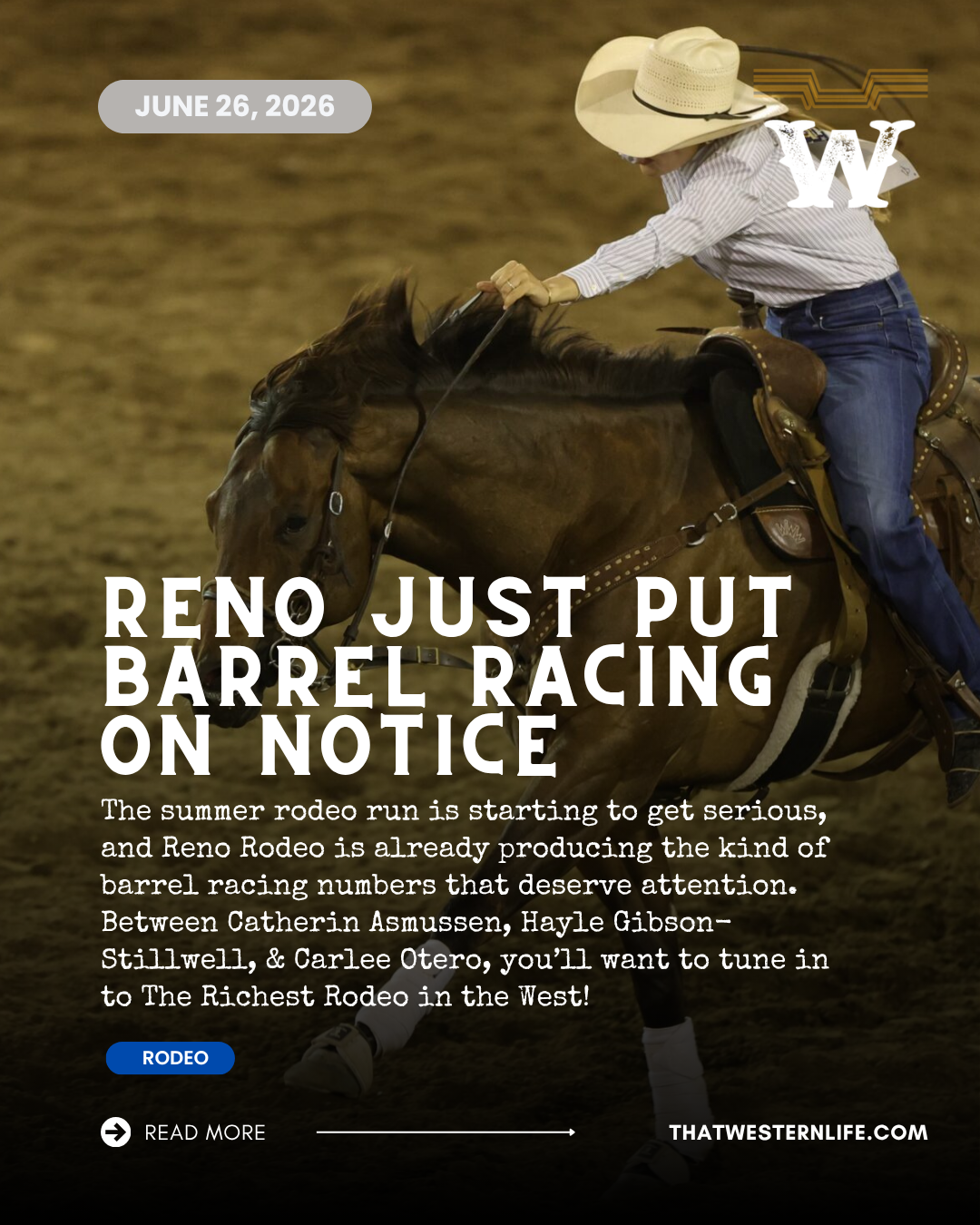
Reno Rodeo is Giving Barrel Racing Fans a Reason to Pay Attention
Reno Rodeo is already giving barrel racing fans something to watch. Catherine Asmussen’s 16.76 in Round 2 put her at the top of a fast field, and with the summer run heating up, every hundredth of a second matters. This is where momentum starts getting real.
The summer rodeo run is starting to get serious, and Reno Rodeo is already producing the kind of barrel racing numbers that deserve attention. The Reno Rodeo is one of the richest rodeos in the west and a must-enter rodeo for many contestants attempting to make the National Finals Rodeo - evident by the emphasis World Champion Tie-Down Roper Shad Mayfield put into using the Reno Rodeo as a launch of his debut back to competitive rodeo post hip surgery.
In the second round of Reno, Catherine Asmussen clocked a 16.76-second run to take control of the field, followed by Hayle Gibson-Stillwell with a 16.88 and Carlee Otero with a 16.94. In a sport where hundredths of a second can separate a check from a missed opportunity, those numbers matter. In fact, the first round leader, Jodee Miller Pedone, sits with a 16.98-second run that is nearly a quarter of a second slower than the round two leaders. Otero currently sits first in the Reno average by 0.12 seconds.
Gibson-Stillwell currently sits number 4 in the WPRA world standings, with Carlee Otero at 6th.
Asmussen will be another one to watch as she seems to heat up in the northwest, placing 8th at Eagle Rodeo (Idaho) and 5th at the Silver State Stampede (Nevada). Regardless, she’s setting herself up well if she is a Wilderness Circuit competitor. Learn more about the PRCA & WPRA Circuits HERE.
Reno is one of the major summer rodeos that can help shape confidence, standings movement, and public awareness before the Fourth of July run hits full speed. For barrel racers, a strong performance in Reno can create momentum at exactly the right time.
Barrel racing is also one of the easiest rodeo events for newer fans to understand. The clock does not leave much room for debate. Fast is fast. Clean is clean. And when the times get tight, every turn becomes part of the story.