
Ep. 129 - **THAT WESTERN PULSE** An Inside Scoop of our July Goals, Strategies, & Tips
The Comeback Is Not the Strategy
The first episode of That Western Pulse begins with a confession.
“Are you nosy about other people’s business?” asks That Western Life founder and host Katie Schrock. “Because I kind of am.”
It is an unusually honest premise for a business program. Most organizations prefer to reveal the polished campaign, the final attendance figure or the celebratory revenue announcement. They rarely publish the abandoned accounts, unfinished systems, missing analytics, awkward baselines or internal debate that came before them.
That Western Life is attempting the opposite.
The twice-monthly That Western Pulse series will examine the internal economics and operating decisions behind rodeo, agriculture, Western events, associations and media. Its first subject is the organization itself: a once-active podcast emerging from roughly two years of dormancy with a new team, a more ambitious publishing operation and a spreadsheet full of publicly stated goals.
The episode introduces Schrock alongside storytellers and strategists Taylie Hammack-Bennett and Kaycie Timm. Together, they outline plans to rebuild the podcast, modernize its brand, increase its digital reach and use both That Western Life and a second, not-yet-disclosed event as live case studies.
On the surface, this is a comeback story.
Underneath it is a more consequential management question:
Can an entrepreneurial media brand become less dependent on the entrepreneur who created it?
When success becomes a capacity problem
That Western Life did not originally go quiet because it had exhausted its subject matter or lost all demand.
Schrock says the podcast helped generate many of the clients, retainers, event assignments and professional relationships that subsequently consumed her available capacity. The platform created opportunities faster than its founder could build the operating structure required to continue publishing it.
That is a peculiar form of success, but not a rare one.
Founder-led businesses often begin with an unusually productive concentration of talent. One person holds the relationships, institutional memory, creative direction, sales instincts, production knowledge and final decision-making authority. This concentration creates speed during the early stages. It also creates fragility.
When every important process passes through one person, growth does not eliminate the bottleneck. It enlarges it.
The founder becomes both the company’s most valuable asset and its most restrictive constraint.
In the podcast’s earlier form, Schrock was not merely a host. She was also a researcher, producer, scheduler, marketer, strategist, connector and, at times, the final quality-control department. Client work generated by the show competed directly with the work required to produce the show. The better the podcast performed as a business-development engine, the harder it became to maintain as a publishing product.
Its interruption was therefore not simply a content failure. It was an operating-model failure.
The relaunch will succeed only if it changes that model.
A better market—and a noisier one
The timing is favorable.
Podcast consumption in the United States reached new highs in 2026. Edison Research found that 58% of Americans age 12 and older had consumed a podcast during the previous month, while 45% had done so during the previous week. Americans now spend approximately 812 million hours per week with podcasts, up 386% from 2016.
The opportunity is no longer restricted to audio.
Fifty-seven percent of Americans age 12 and older have both listened to and watched a podcast. YouTube reports more than 1 billion monthly active viewers of podcast content and describes itself as the most frequently used podcast-listening service in the United States.
For That Western Life, the decision to add video and revive YouTube is therefore not a decorative expansion. It reflects a structural change in the medium. A podcast is increasingly not an audio file promoted with a few social clips. It is a source product distributed through audio, video, search, newsletters, articles and short-form content.
That distinction matters commercially.
The Interactive Advertising Bureau projected that American creator advertising spending would reach $44 billion in 2026, after rising to an estimated $37 billion in 2025. Nearly half of creator-ad buyers surveyed by IAB considered creators a “must buy,” but the same research identified measurement and operational standards as major weaknesses.
The creator economy has become large enough to command real budgets. It has not necessarily become disciplined enough to measure what those budgets purchase.
That Western Pulse is positioning itself inside that gap: part media product, part industry analysis and part public demonstration of what its team can build for others.
That creates opportunity. It also creates an obvious risk. A case study designed partly to attract clients can easily become advertising disguised as analysis.
To remain credible, the series must be willing to publish outcomes that are inconvenient.
The team is the first experiment
The clearest change in the relaunched That Western Life is not its content calendar. It is the composition of the people responsible for fulfilling it.
Hammack-Bennett brings experience as a rodeo competitor, committee participant, photographer and business owner. Her background connects the internal traditions of rodeo with the practical demands of modern event media.
Timm began as a journalist and expanded into photography, video, branding, marketing strategy and coaching. Her role is partly creative and partly diagnostic: she sees gaps between what an organization says it is and how that identity appears in its public assets.
Schrock sits at the center as host, strategist, event producer and organizer. She brings the institutional history, network and commercial context, but the new structure is explicitly designed to prevent every task from remaining hers.
Their geography is notable but not especially troubling. Schrock and Hammack-Bennett are in Oregon; Timm is in Texas. Google’s long-running internal study of team effectiveness found that colocation was not among the factors significantly connected with effectiveness in its teams. What mattered more was how people worked together: psychological safety, dependability, role clarity, meaning and a belief that the work had impact.
Those traits are visible throughout the first episode.
The hosts correct one another, acknowledge mistakes, question their own metrics and admit where they do not yet have an answer. Schrock describes sending “accountability updates” when ranch work and early-morning cattle breeding disrupted the publishing schedule. The response from the team was not to ignore the deadline or condemn the imperfection. It was to protect momentum while refining the process.
That may sound modest. It is not.
A functioning creative team does not remove accountability. It makes accountability survivable.
Timm describes the team’s philosophy through the familiar idea that “all ships rise.” Hammack-Bennett frames the project as an overdue investment in their own intellectual property after years of building businesses, brands and events for other people.
The language is collaborative, but the strategy is economic.
Independent contractors frequently spend their best creative energy increasing the enterprise value of their clients while neglecting their own brands. They build audiences they do not own, archives they cannot reuse and systems that cease to benefit them when the contract ends.
That Western Life offers the team a different kind of asset: a platform whose accumulated value can compound.
A dormant audience is not the same as no audience
The relaunch begins with an advantage unavailable to most new podcasts.
That Western Life already has a name, an archive, search history, industry relationships and residual listening behavior. Schrock reports that old episodes continued to generate downloads during the dormant period, while existing website articles continued attracting search traffic. The podcast also retained approximately 988 active email subscribers and thousands of followers spread across established but largely inactive social accounts.
Dormancy damaged momentum, but it did not erase every asset.
This distinction is central to the case study. A dormant brand is not a blank slate. It is a portfolio of assets in varying condition:
Some are appreciating, such as evergreen articles that still answer useful questions.
Some are deteriorating, such as inactive social audiences that gradually unfollow or disengage.
Some are stranded, such as old episodes that are difficult to discover.
Some are invisible, such as reputation, relationships and audience memory.
Some are liabilities, including outdated branding, broken systems and unreliable historical data.
The managerial task is not merely to “start posting again.” It is to identify which assets retain value, which require repair and which should be abandoned.
Google’s current Search guidance reinforces the potential value of the article archive. The company advises publishers to create original, non-commodity material that satisfies real reader needs and to evaluate the quality of visits through outcomes such as engagement, sales and signups—not clicks alone.
That is particularly relevant for a niche publication.
That Western Life does not need to outpublish general-interest media. It needs to produce material about Western business, rodeo operations, agricultural communications and event economics that broader publishers cannot easily replicate.
Its advantage is not volume. It is proximity.
The numbers reveal the real hypothesis
The team’s July targets initially appear inconsistent.
Follower goals are cautious. Reach goals are audacious.
Facebook followers were expected to move from 4,269 to 4,275—an increase of six. Instagram’s target represented growth of only 45 followers. The email list needed 12 additional active subscribers to reach 1,000.
By contrast, the team wanted website visitors to rise from 274 to 1,000. Facebook views were expected to increase from 316 to 10,000. Instagram views were targeted to rise from approximately 1,100 to 50,000. TikTok views were expected to move from ten to 1,000.
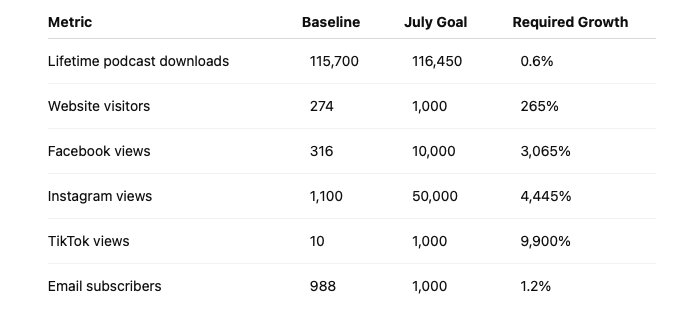
By the Numbers
The percentages are spectacular partly because the starting figures are so small. Increasing TikTok views by 9,900% sounds like hypergrowth; in absolute terms, it requires 990 additional views.
That does not make the goal meaningless. It does make the percentage less informative than it first appears.
Still, the contrast between the two categories reveals a coherent strategic bet:
The team is not expecting immediate audience accumulation. It is testing whether regular publishing can restore distribution.
That is a sensible first-stage objective. A dormant account must begin reaching people again before it can reliably convert them into followers, subscribers, listeners or customers.
But reach is only evidence of distribution. It is not evidence of loyalty, commercial intent or a healthy business.
One successful Reel could carry Instagram past its monthly goal without persuading a single person to listen to a full episode. An old article could produce thousands of search visits without generating a meaningful inquiry. A controversial clip could create awareness while weakening the brand among the audience it hopes to serve.
The next stage of measurement must therefore move beyond raw visibility.
Downloads are not listeners, and leads are not revenue
The episode is most useful when its hosts question their own statistics.
At one point, the team realizes that its proposed “downloads in the first 30 days” measurement cannot be judged at the end of the calendar month because several episodes will not yet have been available for 30 days. Elsewhere, Schrock discovers that some early podcast episodes had expired from the hosting platform, complicating the historical download total.
These are not trivial administrative errors. They illustrate one of the creator economy’s central problems: dashboards make measurement look more settled than it is.
A delivered audio file is not identical to a person listening attentively. Edison distinguishes its listening-based podcast measurement from download analytics for precisely that reason.
A social view is not a completed video.
A follower is not a customer.
A lead is not revenue.
Timm states the distinction particularly well:
“A lead does not in fact generate revenue. However, you will never generate revenue without leads.”
The solution is not to discard top-of-funnel metrics. It is to connect them.
For That Western Life, the more revealing scorecard will eventually include:
Returning website visitors
Episode consumption or completion
Newsletter conversion rates
Replies and substantive audience questions
Qualified commercial inquiries
Partnerships created
Revenue influenced
Production hours per published episode
Content reuse across platforms
The percentage of the operation that can continue without Schrock’s direct intervention
The final metric may be the most important.
If reach increases but the founder remains the point through which every decision, document and deadline must pass, the relaunch will have rebuilt the audience without repairing the company.
The second case study will test the proposition
The team is also applying its model to a Western event that had not been publicly identified when the episode was recorded.
Few details are disclosed, but the stated experiment is clear. The group intends to assemble a creative and strategic team around an event, document the work, track the results and examine what coordinated media coverage can accomplish—even when the event does not possess an extravagant promotional budget.
This is where That Western Pulse could become more valuable than an ordinary behind-the-scenes podcast.
Western events frequently evaluate media as an expense attached to the event rather than an asset created by it. The immediate question becomes how many posts, photographs or videos can be purchased within the available budget.
A more useful question is what those assets must accomplish.
They may need to sell tickets this year. They may also need to prove sponsor fulfillment, recruit volunteers, improve future sponsorship proposals, build an archive, attract competitors, support public relations and preserve the identity of the event for the community that owns it.
A photograph can be a record.
A strategically commissioned photograph can also be sales collateral, sponsor evidence, editorial material, recruitment creative and part of the event’s long-term intellectual property.
The difference lies less in the camera than in the brief.
The undisclosed event will therefore test more than the team’s ability to produce attractive media. It will test whether planning, assignments, distribution and measurement can increase the commercial utility of creative work.
The result should not be judged only by aggregate views. It should be judged by what the event can do after the views have passed.
The Western industry’s hidden operating problem
Rodeo, agriculture and the wider Western economy contain no shortage of ambitious people.
They do contain many organizations attempting to run increasingly sophisticated enterprises through structures built for a simpler era.
Volunteer committees now oversee events with national broadcasts, complex sponsorship agreements, ticketing systems, digital audiences, crisis risks and year-round content demands. Small businesses are expected to communicate across half a dozen platforms while also delivering the product or service that generates their revenue. Contractors are asked to create strategy, capture content, publish it and report results—sometimes without access to the information required to do any of those tasks well.
The resulting problem is often misdiagnosed as a lack of ideas.
It is more commonly a lack of operating capacity.
The hosts repeatedly return to a philosophy of taking the “middle-school sleepover dreams”—the ideas people discuss enthusiastically and then postpone—and converting them into assignments, documents, deadlines and measurable experiments.
That translation is management.
Inspiration may begin a project. Systems allow it to survive its inspiring founder.
The public spreadsheet may be the most important product
That Western Pulse is being introduced as a business feature about the Western lifestyle. Its first season may also become an examination of whether transparency can function as both editorial value and organizational discipline.
Publishing a goal changes the nature of the goal.
It invites scrutiny. It prevents the team from quietly redefining success after the result is known. It also creates an editorial reason to return, analyze and improve.
The project should resist the temptation to make every update triumphant.
The most useful future episode may be the one in which a platform remains stagnant, a campaign fails to convert or the workload proves unsustainable. A credible case study does not merely report what worked. It identifies the assumption that failed and explains what changed as a result.
The same standard should apply to the event case study.
If the media team produces significant reach but little measurable value for the event, the series should say so. If volunteer coordination creates friction, it should examine the structure rather than hiding it. If one channel performs far better than expected, the team should determine whether the result can be repeated or was simply an outlier.
That is how the series can separate itself from the large supply of business content built around retrospective certainty.
The hosts do not yet know whether all the goals will be met. They do not know exactly how the partnerships, sponsorships or lead pipeline will develop. Some of the original measurements need refinement. The operational structure is still being built while the work is already moving through it.
That uncertainty is not a weakness in the story.
It is the story.
What happens next
That Western Life is attempting two related experiments.
The first asks whether an established but dormant media brand can restore momentum through disciplined publishing, better distribution and a team built around complementary abilities.
The second asks whether that team can apply the same principles to an outside Western event and produce value that extends beyond attractive content and temporary attention.
Both experiments will ultimately turn on the same issue.
The Western industry does not need more people telling it that storytelling matters. It needs clearer evidence of what good storytelling accomplishes, what it costs, how it should be organized and which business outcomes it can reasonably influence.
The comeback is useful.
The operating system behind it will determine whether it lasts.